
IVF cost without insurance is one of the biggest financial shocks in fertility care, mostly because the number people hear first is rarely the number they actually pay. Clinics often quote a “base cycle” fee, then medications, monitoring, and lab add-ons show up separately and push the real total much higher.
This guide breaks down IVF cost without insurance in 2026: what a full cycle actually includes, what add-ons typically cost, why most patients need more than one cycle, and realistic ways to lower the total bill. For related comparisons, see IUI cost vs IVF cost, IVF cost by state, and donor egg IVF cost if own-egg IVF isn’t your path.
This article is for general informational purposes only. It is not medical advice and does not replace a consultation with a fertility specialist. Figures are 2026 industry estimates based on published clinic pricing and fertility-finance data. Ask your clinic for a written, itemized quote before starting treatment.
Quick Answer
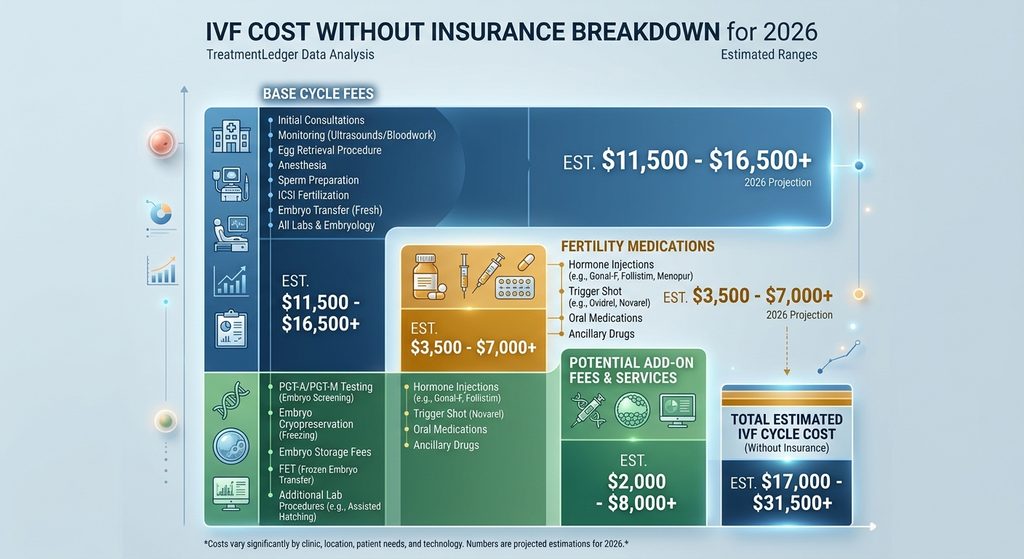
Without insurance, a single IVF cycle in the US typically costs $15,000 to $30,000 once medications and standard add-ons are included. Many clinics quote a lower base fee — often $12,000 to $17,000 — but that figure usually excludes medications and several common procedures.
Because most patients need more than one cycle, realistic total budgets often land between $40,000 and $75,000 for people using their own eggs, and $100,000+ for cycles involving donor eggs.
Why the “Base Price” Isn’t the Real IVF Cost
When a clinic advertises IVF cost without insurance as a single number, that figure usually covers only the core procedure: monitoring, egg retrieval, fertilization, and embryo transfer. It rarely includes the pieces below, which apply to most patients:
| Add-on | Typical additional cost |
|---|---|
| Medications (stimulation drugs) | $3,000 – $7,000 |
| ICSI (intracytoplasmic sperm injection) | $2,000 – $3,000 |
| PGT-A genetic testing of embryos | $3,000 – $6,000 |
| Frozen embryo transfer (FET), per transfer | ~$5,000 |
| Embryo cryopreservation/storage | $800 – $1,500 per year |
| Donor eggs | $15,000 – $20,000+ |
Add even two or three of these to a base fee, and a $15,000 quote can easily become a $25,000–$30,000 real bill. Always ask for a full, itemized estimate that includes medications and the specific add-ons your doctor expects you’ll need.
IVF Cost Without Insurance by Scenario
| Scenario | Typical total cost |
|---|---|
| One cycle, own eggs, no major add-ons | $15,000 – $20,000 |
| One cycle, own eggs, with medications + ICSI + PGT-A | $25,000 – $35,000 |
| Two to three cycles, own eggs (realistic total) | $40,000 – $75,000+ |
| Cycle using donor eggs | $30,000 – $45,000+ per cycle |
| IUI (a lower-cost alternative some try first) | $1,200 – $2,350 per cycle |
IUI (intrauterine insemination) costs far less per attempt, but success rates run lower — roughly 8–15% per cycle, compared to about 20% per IVF cycle. For some patients, especially with unexplained infertility, starting with IVF actually costs less per live birth than several rounds of IUI, even though each individual IVF cycle costs more upfront. This is worth discussing with your doctor rather than assuming the cheaper option per cycle is cheaper overall.
Why “Without Insurance” Applies to So Many Patients
Fertility coverage in the US is a patchwork. Roughly 15 to 20 states currently require some form of infertility or IVF coverage, but two things limit how many people that actually helps:
- Self-funded employer health plans are exempt from state insurance mandates in most cases, and self-funded plans cover the majority of Americans with employer-sponsored insurance.
- Even in mandate states, coverage often comes with limits — a capped number of egg retrievals, age restrictions, or lifetime dollar caps.
That’s why so many patients face IVF cost without insurance even while living in a state that technically “requires” coverage. If you have employer insurance, it’s worth confirming directly with HR whether your plan is self-funded and whether it includes a fertility benefit, since this isn’t always obvious from your insurance card alone.
Real Ways to Lower IVF Cost Without Insurance
- HSA and FSA accounts. IVF medications, monitoring, and procedures are eligible expenses under both Health Savings Accounts and Flexible Spending Accounts. Because these use pre-tax dollars, you effectively save at your marginal tax rate — commonly 22–37% depending on income.
- Employer fertility benefits. Some large employers offer fertility benefits worth $15,000–$50,000 even without a state mandate. Ask HR directly; this benefit isn’t always advertised alongside standard health insurance.
- Multi-cycle packages. Some clinics offer discounted pricing for committing to two or three cycles upfront, sometimes with a partial refund if none succeed. Read the refund conditions carefully — they usually require meeting specific medical eligibility criteria.
- Fertility grants and nonprofit assistance. Several nonprofit organizations award grants that cover part or all of a cycle for qualifying applicants. Competition for these is high, so apply early and to more than one program. See our full fertility grants and financial assistance guide for the major programs and typical award amounts.
- Medication savings programs. Manufacturer discount programs and pharmacy coupons can meaningfully reduce the medication portion of your bill, which is often the single largest add-on cost.
The American Society for Reproductive Medicine publishes patient fact sheets on treatment options and typical costs, and RESOLVE: The National Infertility Association maintains an updated list of state insurance mandates and financial assistance programs.
Red Flags When Comparing IVF Cost Without Insurance
Fertility care is emotionally difficult, and some advertising takes advantage of that. Before choosing a clinic based on price:
- Ask exactly what’s included in the quoted “cycle” price, and what’s billed separately
- Compare clinic-reported success rates for patients in your age group and diagnosis, not just the overall clinic average
- Be cautious of guarantees or “100% money-back” packages without clear, written eligibility criteria
- Confirm whether monitoring appointments require travel to a specific clinic location, which can add real cost and time off work
Frequently Asked Questions
Is IVF cost without insurance the same everywhere in the US? No. Clinics in expensive metro areas and states like California, New York, and Massachusetts tend to charge more than clinics in lower cost-of-living states. Multi-cycle discount clinics in some regions also price noticeably below the national average.
How many cycles do most people need? It varies by age, diagnosis, and clinic, but many patients need two to three cycles to achieve a pregnancy. Ask your clinic for their live birth rate per cycle for patients with a profile similar to yours, not just their overall success rate.
Does IVF cost without insurance include medications? Usually not in the advertised base price. Medications typically add $3,000–$7,000 per cycle and vary significantly based on your protocol and how your body responds to stimulation.
Are cheaper IVF cycles abroad worth considering? Some patients do pursue treatment outside the US to reduce cost, but this adds travel, timing, and follow-up-care logistics that are worth weighing carefully alongside the price difference.
Sources and pricing benchmarks referenced in this guide come from 2026 fertility-finance industry data and clinic pricing information published in the US. This article doesn’t recommend any specific clinic or financing provider. Confirm current pricing directly with a fertility clinic, and speak with a licensed reproductive endocrinologist to discuss what treatment path is right for you.