
Dental insurance for implants is confusing by design, not by accident. Plans that technically “cover” implants often bury a 12-month waiting period in the fine print. Others cap the annual maximum so low that the reimbursement barely registers against a $3,000–$6,500 implant. The difference between a well-chosen plan and a poorly chosen one can mean $1,500 or more in out-of-pocket cost for a single tooth.
This guide compares the best dental insurance for implants by specific situation — needing treatment soon, wanting the highest annual maximum, or switching from a prior plan. That way you can match a plan to your actual timeline, not just its marketing. See our full mouth dental implants cost guide if you need a plan for more extensive treatment.
This article is for general informational purposes only. It is not financial or insurance advice. Plan details, coverage percentages, and waiting periods change frequently and vary by state and specific plan tier. Confirm current terms directly with each insurer before enrolling.
Quick Answer
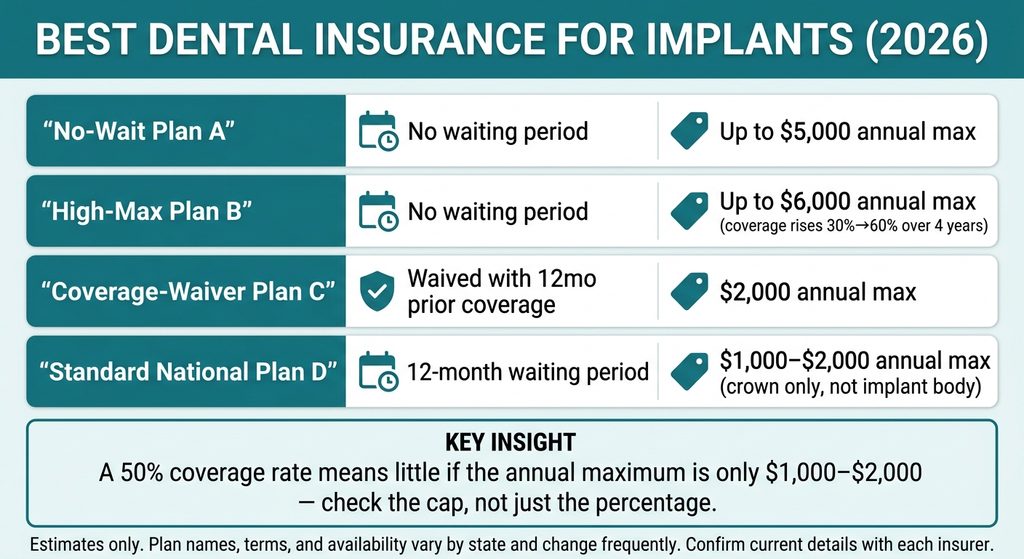
For patients needing implant treatment soon, Spirit Dental and Denali Dental stand out for having no waiting period on major services, including implants — unusual in this market. Most competitors impose 6 to 12 months before implant benefits begin. If you want the highest annual maximum, Denali Summit PPO offers up to $6,000 per year. Patients switching from existing coverage can look at Humana Loyalty Plus, which waives its waiting period entirely if you can document 12 months of prior continuous dental coverage.
Because most standard plans cap annual benefits at $1,000 to $2,000 — often exhausted well before a full implant is finished — the annual maximum matters just as much as the coverage percentage.
Best Dental Insurance for Implants, by Situation
| Situation | Best-fit plan | Key detail |
|---|---|---|
| Need treatment soon, no waiting period | Spirit Dental | No waiting period on major services; some plans pay 25% year one, 50% after; up to $5,000 annual max depending on tier |
| Highest annual maximum | Denali Summit PPO | Up to $6,000 annual max; no waiting period; incremental coverage rising from 30% to 60% over 4 years |
| Switching from prior coverage | Humana Loyalty Plus | Waives waiting period entirely with 12 months of documented prior continuous dental coverage |
| Budget-conscious, still want implant coverage | Guardian Direct Core | ~$19/month; 50% coverage for implants, crowns, and fillings; no waiting period; 120,000+ dentist network |
| Prefer a familiar national carrier | Delta Dental PPO Premier, Cigna Dental 2000, or MetLife PPO | 50% implant coverage after a standard 12-month waiting period; often covers only the crown/restoration, not the surgical implant body |
The Annual Maximum Problem
This is the detail that undermines even a plan that technically “covers” implants. Most standard dental plans cap annual benefits at $1,000 to $2,000. Since a single implant typically costs $3,000 to $6,500, even a generous 50% coverage rate on a $5,000 implant would theoretically pay $2,500. But a standard plan’s $1,000–$2,000 cap exhausts long before that math plays out. As one dentist put it plainly: the percentage covered is almost beside the point if the annual cap is too low to matter.
Because of this, a plan advertising “50% implant coverage” isn’t automatically a good deal — the annual maximum determines how much of that 50% you can actually collect in a given year.
Why Waiting Periods Exist (and How to Avoid Losing to One)
Insurers impose waiting periods — commonly 6 to 12 months for major services like implants — to prevent people from enrolling specifically to use an expensive benefit immediately, then canceling. That logic makes sense from the insurer’s side. It’s genuinely frustrating, though, if you need treatment soon.
A few ways around this:
- Choose a no-waiting-period plan (Spirit Dental and Denali Dental both offer this for major services, including implants)
- Ask about a continuous-coverage waiver, like Humana’s, which waives the waiting period if you can document prior dental coverage without a gap
- Time your enrollment well before you expect to need treatment, if your timeline allows it
Watch for the Crown-vs-Implant-Body Distinction
Many plans that list implants as “covered” only cover the crown and restoration work, not the surgical implant post itself. That’s the same split covered in our single tooth implant cost guide. Delta Dental, Cigna, and several other national carriers commonly fall into this pattern: 50% coverage after a waiting period, but only on the restorative portion. Before enrolling based on “implant coverage,” ask specifically whether that includes the surgical placement or only the crown placed on top of it.
Incremental Coverage: A Detail Easy to Miss
Some plans, including Denali’s, use incremental coverage models rather than a flat percentage from day one. Denali’s Summit plan, for example, starts at 30% implant coverage in year one and increases by 10% annually, reaching 60% by year four. If you’re comparing two plans’ headline coverage percentages, confirm whether that number applies immediately or only after several years of continuous enrollment. A “60% coverage” plan that only reaches that rate in year four isn’t the same offer as a plan providing 60% from day one.
The American Dental Association publishes general guidance on how dental insurance typically classifies and covers implant procedures, independent of any specific insurer.
Questions to Ask Before You Enroll
- Is there a waiting period for implant coverage specifically, and how long is it?
- Does coverage apply to the surgical implant post, the crown and abutment, or both?
- What’s the annual maximum, and how does that interact with the coverage percentage for a realistic implant cost?
- Does coverage increase over time (an incremental model), or is the stated percentage available from day one?
- Is my specific dentist or oral surgeon in-network, and does that change my out-of-pocket cost?
Frequently Asked Questions
Is there really a dental insurance plan with no waiting period for implants? Yes, a small number of plans — Spirit Dental and Denali Dental among the most commonly cited — offer no waiting period on major services, including implants, which is uncommon in this market.
Why does my plan say it covers implants, but the reimbursement was much smaller than expected? This usually comes down to the annual maximum. Even a 50% coverage rate on an expensive implant can be capped well below that theoretical amount if your plan’s yearly maximum is only $1,000 to $2,000.
Does Medicare ever help pay for dental implants? Original Medicare doesn’t cover dental implants at all. Some Medicare Advantage plans include limited dental benefits with their own separate caps, so checking your specific plan’s dental rider is worth doing if you’re on Medicare and considering an implant.
Should I switch dental insurance plans specifically to get implant coverage? It can make sense if you’re planning treatment far enough in advance to clear a waiting period, or if you qualify for a waiver like Humana’s. Run the math on annual maximum versus your actual implant cost before assuming a “covers implants” plan will meaningfully lower your bill.
Sources and plan details referenced in this guide come from 2026 insurer-published plan documents and industry comparison data. This article doesn’t recommend any specific insurance plan as the definitive best choice for every situation. Confirm current coverage, waiting periods, and annual maximums directly with each insurer before enrolling.