
Hair transplant cost is one of the most confusing numbers in medicine. Two patients with similar hair loss can walk out of two different clinics with quotes that differ by tens of thousands of dollars. That gap isn’t random. A few clear factors drive it: how many grafts you need, which technique your surgeon uses, their experience level, and where the clinic is located.
This guide breaks down real hair transplant cost ranges for 2026 — by graft count, technique, and country — plus financing options and the red flags that signal an unrealistic quote. For a deeper look at the per-graft math itself, see our hair transplant cost per graft guide, or hair transplant cost Turkey vs US if you’re specifically weighing medical tourism.
This article is for general informational purposes only. It is not medical advice and does not replace a consultation with a board-certified surgeon. Figures are 2026 industry estimates based on publicly available clinic and financing data. Get a written quote from a provider before making any decision.
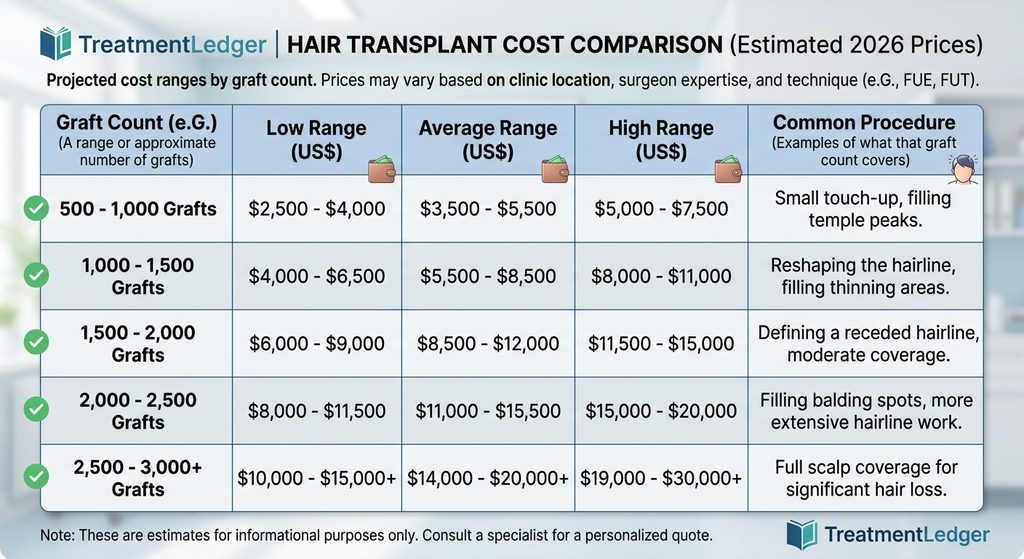
Quick Answer
In the United States, hair transplant cost typically falls between $4,000 and $15,000, with most patients paying $8,000 to $13,000 for a standard session. Larger, more complex cases can push hair transplant cost past $20,000. Outside the US, the same procedure is often available for a fraction of the price, which is why medical tourism plays such a large role in this industry.
The two numbers that matter most when you compare quotes: the graft count you actually need, and the price per graft the clinic charges.
What Affects Hair Transplant Cost?
1. Number of grafts
Clinics usually price a procedure per graft or as a flat package. A “graft” is a small unit of skin holding one to four hairs, moved from a donor area — usually the back or sides of the scalp — to the thinning or bald area.
- Small touch-up sessions (hairline work, early thinning): roughly 800–1,500 grafts
- Moderate restoration: roughly 1,500–2,500 grafts
- Extensive restoration (advanced hair loss, larger areas): 3,000–4,500+ grafts
Graft count usually drives hair transplant cost more than any other single factor.
2. Technique: FUE vs. FUT
- FUT (“strip method”) — surgeons remove a strip of scalp and dissect it into individual grafts under a microscope. This is generally the cheaper option, around $3–$7 per graft, but it leaves a linear scar and takes longer to heal.
- FUE (Follicular Unit Extraction) — surgeons extract individual follicles one at a time with a small punch tool, so there’s no linear scar. It takes more surgical time, so it typically costs $4–$10 per graft, sometimes more with in-demand specialists.
Some clinics also offer robotic-assisted FUE or DHI (Direct Hair Implantation), which usually adds a premium on top of standard FUE pricing.
3. Surgeon experience and clinic model
This is where hair transplant cost spreads the most. A board-certified surgeon who personally performs the extraction and implantation will almost always charge more than a high-volume, technician-run clinic. That premium typically buys:
- A lower risk of graft damage during extraction, which affects how many transplanted hairs survive
- More consistent, natural-looking results
- Real follow-up care if something needs adjusting later
If a quote looks unusually low for a large graft count, ask who actually performs the surgery.
4. Location
Clinics in expensive metro areas charge more than clinics in smaller markets. This price gap is also the main reason medical tourism exists in this industry — see the country comparison below.
Hair Transplant Cost by Graft Count (US Averages)
| Grafts needed | Typical FUT cost | Typical FUE cost |
|---|---|---|
| 1,000 grafts | $3,000 – $8,000 | $4,000 – $10,000 |
| 2,000 grafts | $6,000 – $14,000 | $8,000 – $20,000 |
| 3,000 grafts | $9,000 – $21,000 | $12,000 – $30,000 |
| 4,000+ grafts | $12,000+ | $16,000 – $36,000+ |
These ranges are illustrative. Always ask for an itemized quote based on your own graft estimate, since per-graft pricing can vary a lot between clinics using the same technique.
Hair Transplant Cost by Country
The same procedure, done by an experienced team, often costs far less outside the US. That’s why medical tourism has grown so much around hair restoration, especially in Turkey.
| Country | Typical cost (2,500–3,000 graft FUE) |
|---|---|
| United States | $8,000 – $25,000+ |
| United Kingdom / Australia | $8,000 – $18,000 |
| Turkey | $1,500 – $4,500 (often all-inclusive with hotel and transfers) |
| Mexico | $2,500 – $6,000 |
| Thailand / Poland / Hungary | $2,000 – $8,000 |
| India | $1,200 – $4,000 |
Lower prices abroad usually reflect lower wages, rent, and overhead — not automatically lower quality. Some of the highest-volume, most experienced clinics in the world operate in destinations like Istanbul. Still, medical travel carries real trade-offs:
- Limited or no in-person follow-up if you need a correction
- Language barriers during consultation and aftercare
- Travel and recovery logistics (you generally can’t fly right after surgery)
- Harder recourse if something goes wrong
If price is your main reason for traveling abroad, research the specific clinic and surgeon — not just the country — as carefully as you would a local provider. The ISHRS patient resource center publishes guidance on vetting hair restoration providers anywhere in the world.
Does Insurance Cover Hair Transplant Cost?
Almost never. US health insurers classify hair transplantation as cosmetic and elective, so they exclude it — even under plans that cover other dermatological conditions. Rare exceptions exist, such as reconstructive cases after an accident, burn, or certain scalp conditions, but insurers evaluate these case by case and require documentation from a physician. The American Academy of Dermatology has a helpful overview of which hair-loss treatments are typically considered medical versus cosmetic.
Because coverage is so rare, most patients pay out of pocket or finance the procedure.
How People Cover Hair Transplant Cost: Financing Options
Since insurance rarely applies, financing plays a big role here. Common options include:
- In-house clinic payment plans — many larger practices offer their own installment plans, sometimes interest-free for a limited period.
- Medical financing companies — dedicated healthcare credit lines usable across many providers, often with promotional 0% periods and higher deferred interest if you don’t pay in time.
- Personal loans — a fixed-rate, fixed-term loan from a bank, credit union, or online lender. Payments stay predictable, but you’ll need a credit check.
- Credit cards — flexible, but usually the most expensive route if you don’t clear the balance quickly.
Compare the total cost over the life of the loan, not just the monthly payment. Promotional 0% financing can carry steep retroactive interest if you don’t clear the balance by the end of the promo period.
Hidden Costs That Add to Your Final Bill
A per-graft price rarely tells the whole story. Ask each clinic whether these are included:
- Pre-operative consultation and lab work
- Anesthesia and medication (post-op pain relief, antibiotics)
- PRP (platelet-rich plasma) or other add-ons meant to support graft survival
- Post-op supplies: special shampoo, bandages, follow-up visits
- A second procedure, if you’re likely to need one for extra density later
Get a full, itemized quote in writing. It’s the best way to avoid a surprise on the final invoice.
Red Flags: When Hair Transplant Cost Looks Too Good to Be True
A hair transplant is real surgery. Pricing well below the ranges above for a comparable graft count deserves a closer look. Before you book, ask:
- Who actually performs the extraction and implantation — the surgeon, or a technician team?
- Which technique are they using, and does the price match what that technique typically costs?
- What’s included in the quote, and what gets billed separately afterward?
- Can they show before-and-after results from patients with hair loss similar to yours?
Frequently Asked Questions
How many grafts do most people need? It depends on the extent of hair loss and the area being treated. Many patients need somewhere between 1,500 and 3,000 grafts for a first session. Only a consultation with a qualified provider can give you a real number.
Is a lower hair transplant cost abroad a bad idea? Not necessarily. Some international clinics have very high case volume and strong outcomes. The real risk is choosing a clinic on price alone, without researching its track record, and underestimating what follow-up care looks like if you need a touch-up.
Will I need more than one session? Some patients do, especially those with more advanced hair loss who want higher density than one session can safely deliver. Ask about this upfront so it’s part of your budget from the start, not a surprise “phase two.”
Does a higher hair transplant cost always mean a better result? Not automatically. But a very low price for a large graft count is a legitimate reason to ask more questions about who actually does the surgical work.
Sources and pricing benchmarks referenced in this guide come from 2026 industry pricing data, financing-provider reports, and publicly available clinic pricing in the US and abroad. This article doesn’t recommend any specific clinic, surgeon, or financing provider. Verify current pricing directly with a provider, and consult a board-certified physician to decide whether the procedure is right for you.