
Medical loans for surgery need to cover larger amounts than a typical medical bill, which rules out some financing options and makes others a much better fit. A $5,000 dental credit line works differently than a $40,000 loan for bariatric surgery or IVF, so the “best” lender depends heavily on how much you need to borrow and your credit profile.
This guide compares medical loans for surgery by real APR ranges, credit score requirements, and maximum loan amounts, so you can see which lender actually fits your situation before you apply.
This article is for general informational purposes only. It is not financial advice and does not replace a conversation with a licensed financial advisor. Figures are 2026 industry estimates based on published lender terms. Rates and terms change frequently — confirm current numbers directly with each lender before applying.
Quick Answer
Among medical loans for surgery, LightStream offers the lowest rates but requires strong credit (roughly 720+). SoFi handles the largest amounts, up to $100,000, with possible same-day funding. Upgrade and Prosper serve fair-credit borrowers (580+ and 560+ respectively), at higher APRs. CareCredit works well only if you can pay off the balance within its 0% promotional window — its standard rate afterward runs considerably higher than most personal loan options.
Because credit score requirements vary so much between these lenders, checking your prequalified rate with more than one — most use a soft credit check that doesn’t affect your score — is worth the extra few minutes before committing.
Medical Loans for Surgery Compared
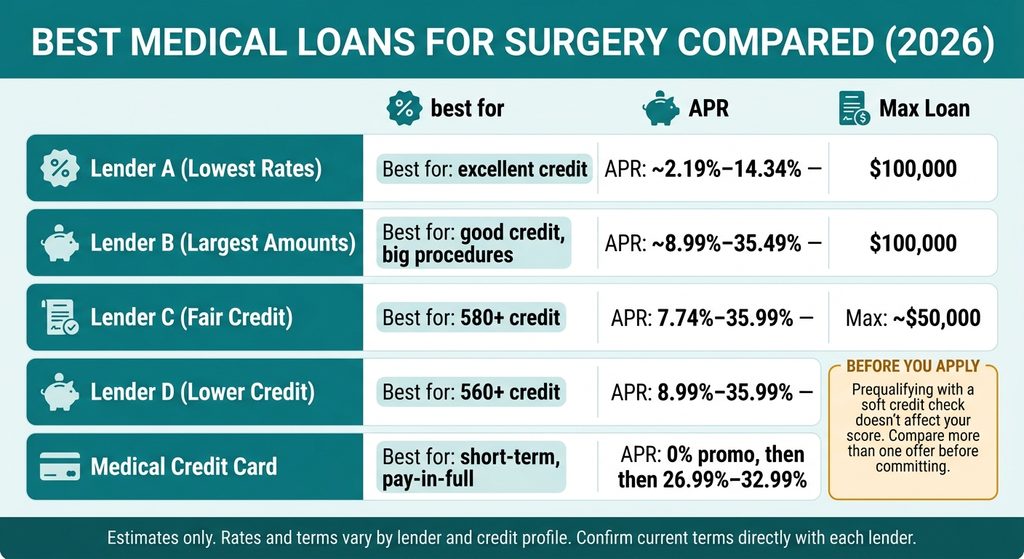
| Lender | Best for | Typical APR | Min. credit score | Max. loan amount |
|---|---|---|---|---|
| LightStream | Lowest rates, excellent credit | ~2.19% – 14.34% | ~720+ | $100,000 |
| SoFi | Largest loan amounts | ~8.99% – 35.49% | Good credit | $100,000 |
| Upgrade | Fair-credit borrowers | 7.74% – 35.99% | 580+ | ~$50,000 |
| Prosper | Lower credit scores | 8.99% – 35.99% | 560+ | $50,000 |
| Prosper Healthcare Lending | Specialty procedures (cosmetic, dental, bariatric, fertility) | Starting around 5.99% | Varies | Varies by provider |
| CareCredit | Short-term, pay-in-full promo plans | 0% if paid in full during promo; 26.99%–32.99% standard | ~620+ | Varies by provider limit |
Rates shown reflect ranges reported across 2026 lender data and marketplaces; your actual rate depends on your specific credit profile, loan amount, and term length.
Best for Large Amounts: SoFi
Surgery often costs more than a standard personal loan lender’s typical cap. SoFi stands out here, offering loans up to $100,000 — well above the $50,000 ceiling common at many other lenders. That makes it a strong fit for major procedures like bariatric surgery, IVF, or combined cosmetic procedures, where a smaller loan simply wouldn’t cover the total. SoFi also offers potential same-day funding for approved borrowers, though approval favors good to excellent credit.
Best for Lowest Rates: LightStream
If you qualify, LightStream typically offers the lowest rates among medical loans for surgery, with no fees and terms as long as 20 years. It also allows amounts up to $100,000, matching SoFi at the high end. The trade-off is underwriting: LightStream favors borrowers with several years of on-time payment history, stable income, and existing savings, so it works best for applicants with an already strong credit profile rather than as a first stop for building credit.
Best for Fair Credit: Upgrade and Prosper
Not every applicant qualifies for LightStream’s requirements. Two lenders serve a lower credit range specifically:
- Upgrade accepts credit scores as low as 580, with APRs from 7.74% to 35.99% and an origination fee of 1.85%–9.99%. For borrowers with credit in the 620–680 range needing $5,000–$15,000, Upgrade is often a realistic middle-ground option.
- Prosper, a peer-to-peer lender, accepts scores as low as 560 and explicitly lists cosmetic surgery as an approved loan purpose. Its origination fee (1%–9.99%) adds cost, but for borrowers locked out of traditional lenders, it offers a legitimate path to financing.
Both charge meaningfully higher APRs than LightStream at the low end of their credit ranges, so the trade-off is accessibility versus rate.
Specialty Lenders: Prosper Healthcare Lending and Similar
Some lenders focus specifically on medical financing rather than general personal loans. Prosper Healthcare Lending, for example, serves only cosmetic, dental, bariatric, and fertility procedures, with starting rates around 5.99% and a business model built around provider integration. Because these lenders limit their scope to specific specialties, they aren’t a fit for every procedure — but within their lane, they sometimes beat general personal loan rates for well-qualified borrowers.
CareCredit: Useful for a Narrow Case
CareCredit remains one of the most widely accepted medical financing options, but it works best in a specific scenario: a smaller balance you’re confident you can pay off entirely within its promotional 0% period (commonly 6–24 months). If you don’t clear the balance in time, the standard rate — commonly cited between 26.99% and 32.99% depending on the specific offer — applies retroactively to the full original amount, not just what remains.
Worth knowing before you apply: CareCredit’s issuer faced a $34 million settlement with the Consumer Financial Protection Bureau in 2013 over deceptive enrollment practices. That history doesn’t mean the product is unusable today, but it’s a reasonable reason to read the terms carefully rather than assuming “0% financing” always means what it sounds like.
The Consumer Financial Protection Bureau publishes guidance on comparing medical financing offers and understanding deferred-interest terms, independent of any specific lender.
How to Choose Based on Your Credit Score
- 720+ credit: LightStream and SoFi typically offer the lowest rates and highest loan amounts — worth checking both before deciding.
- 620–680 credit: Upgrade, CareCredit (if you can pay off the promo balance), and Prosper Healthcare Lending (if your procedure qualifies) are realistic middle options.
- Below 620 credit: Prosper and Upgrade both go lower than most traditional lenders, though at higher APRs. A no-credit-check option through a specific provider may also be worth exploring, understanding that convenience usually comes with a higher effective cost.
Questions to Ask Before You Apply
- Does checking my rate involve a hard credit inquiry, or only a soft check to prequalify?
- Is this a true 0% APR offer, or deferred interest that applies retroactively if I miss the payoff date?
- What’s the origination fee, and is it deducted from my loan proceeds or added to my balance?
- Does this lender fund the provider directly, or send funds to me first?
- What’s the maximum amount available, and does it cover my full expected procedure cost?
Frequently Asked Questions
Which lender is best for a single large surgery, like bariatric or fertility treatment? SoFi and LightStream both offer loans up to $100,000, making them well-suited to larger procedures, provided your credit qualifies. Prosper Healthcare Lending is also worth checking if your specific procedure falls within its supported specialties.
Is it worth checking my rate at more than one lender? Yes. Most reputable lenders let you prequalify with a soft credit check that doesn’t affect your score, so comparing your actual offered rate across two or three lenders costs nothing but a few minutes.
Why does CareCredit show both a 0% rate and a 26.99%–32.99% rate? CareCredit’s promotional financing uses deferred interest. You pay 0% only if you clear the full promotional balance by the deadline; otherwise, the standard rate applies retroactively to the entire original amount.
Can I combine more than one financing option for a single surgery? Some patients do, such as using a personal loan for the bulk of the cost and HSA/FSA funds for a smaller portion. Confirm with your provider how they handle payments from multiple sources before your procedure date.
Sources and figures referenced in this guide come from 2026 lender-published terms and consumer-finance marketplace data. This article doesn’t recommend any specific lender. Confirm current rates, fees, and terms directly with each lender before applying, and consult a financial advisor if you’re unsure which option fits your situation.