
Medical financing options look similar on the surface — most promise to spread a big bill into smaller payments — but the fine print between them varies enough to cost you hundreds or thousands of dollars extra if you pick the wrong one. The single biggest trap in this space is deferred interest, a feature that charges you interest retroactively from the original purchase date if you don’t pay off the full balance in time.
This guide compares medical financing options directly: real APRs, loan amounts, credit requirements, and which option tends to fit which situation.
This article is for general informational purposes only. It is not financial advice and does not replace a conversation with a licensed financial advisor. Figures are 2026 industry estimates based on published lender terms and consumer-finance data. Confirm current rates and terms directly with each provider before applying.
Quick Answer
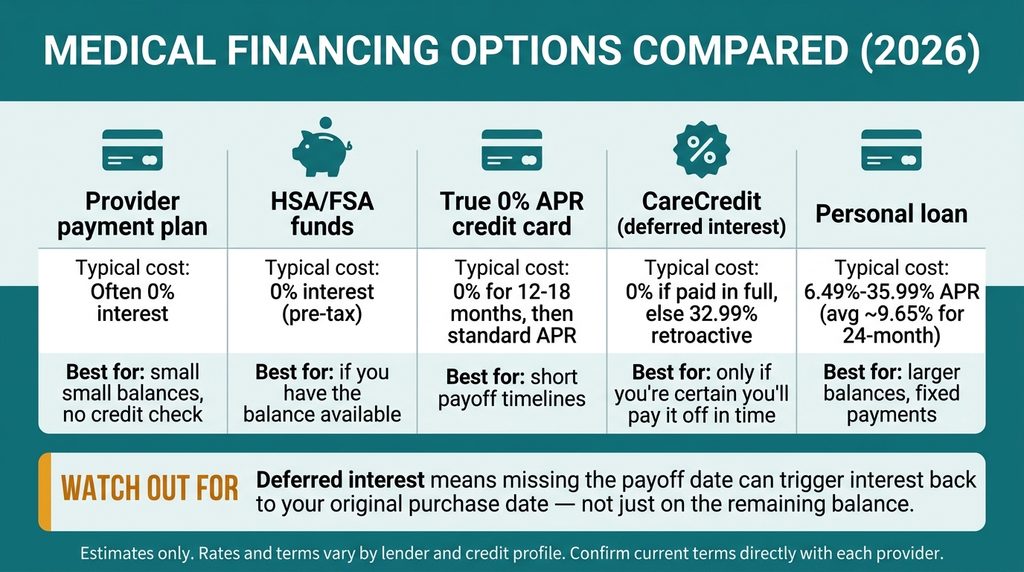
Among medical financing options, provider in-house payment plans and HSA/FSA funds cost the least, since neither charges interest. For financed amounts, true 0% APR credit cards and soft-check platforms like Cherry offer the best terms if you qualify and can pay the balance off during the promotional period. Personal loans work best for larger, longer-term balances, with 24-month rates averaging around 9.65% for well-qualified borrowers. CareCredit’s deferred-interest plans carry real risk: miss the payoff deadline, and you owe interest retroactively at up to 32.99%.
Because the “best” option depends heavily on your credit profile and how quickly you can repay, comparing more than one lender before committing is worth the extra few minutes it takes.
Medical Financing Options Compared
| Option | Typical cost | Loan amount | Credit impact |
|---|---|---|---|
| Provider in-house payment plan | Often 0% interest | Varies by provider | Usually no credit check |
| HSA/FSA funds | 0% interest (pre-tax dollars) | Limited to your account balance | None |
| True 0% APR credit card | 0% if paid off in 12–18 months, then standard card APR | Your approved credit limit | Hard inquiry |
| CareCredit (deferred interest) | 0% if paid in full during promo; 32.99% retroactive if not | Varies by provider limit | Hard inquiry |
| CareCredit (reduced APR plans) | 13.90%–17.90% fixed, from month one | Typically $1,000+ | Hard inquiry |
| Personal loan (bank, credit union, online lender) | 6.49%–35.99% APR depending on credit | $1,000 – $100,000 | Soft check to prequalify, hard check to accept |
| Soft-check BNPL (Cherry, Sunbit) | True 0% for qualified borrowers; otherwise tiered APR | Up to $65,000 (varies by platform) | Soft check, doesn’t affect credit score |
| No-credit-check financing (Denefits and similar) | Often higher effective cost | Provider-dependent | No credit check at all |
The Deferred-Interest Trap: Why CareCredit Needs Extra Care
CareCredit is the most widely accepted medical credit card, taken at more than 270,000 locations, which makes it convenient. That convenience comes with a specific risk worth understanding before you sign up.
CareCredit’s standard promotional offers use deferred interest, not true 0% APR. If you pay off the full promotional balance by the end of the period (commonly 6, 12, 18, or 24 months), you owe nothing extra. But if even a small balance remains when the promotional period ends, the card charges interest retroactively — back to your original purchase date — at the standard APR of around 32.99%.
This differs meaningfully from a true 0% APR general-purpose credit card, which only charges interest on whatever balance remains after the intro period, not retroactively on the entire original amount. Because of this difference, a true 0% card from your bank can sometimes beat CareCredit even though both advertise “0% financing.”
For larger purchases, CareCredit also offers reduced-APR plans (currently around 13.90%–17.90%, fixed) that charge interest from month one but at a lower rate than the standard 32.99% — a more predictable option if you know you can’t pay off the full balance within a short promotional window. See our full CareCredit review for real complaint patterns and a worked example of how the deferred interest actually plays out.
Personal Loans: Best for Larger, Longer-Term Balances
Personal loans from banks, credit unions, and online lenders work differently from revolving credit cards. You receive a lump sum upfront and repay it in fixed monthly installments over a set term, typically 2 to 7 years. Rates vary widely by credit profile — recent NerdWallet-tracked lenders show APRs ranging from about 6.49% to 35.99%, with the 24-month average landing near 9.65% for qualified borrowers.
Personal loans tend to make the most sense when:
- You need a larger amount than a typical credit card limit covers
- You know you can’t realistically pay off the balance within a short 0% promotional window
- You want a fixed, predictable monthly payment rather than revolving credit
Most reputable lenders let you prequalify with a soft credit check that doesn’t affect your score, so comparing your actual rate across two or three lenders before committing costs you nothing but time. For a direct head-to-head, see our guide to personal loan vs credit card for medical bills.
Buy-Now-Pay-Later and Soft-Check Platforms
A newer category of medical financing options has grown alongside traditional credit cards and loans. Platforms like Cherry, Sunbit, and Affirm use a soft credit check to give an instant decision, often approving borrowers across a wide range of credit scores, without the hard inquiry a traditional loan or credit card requires upfront.
- Cherry advertises true 0% APR for qualified borrowers and loan amounts up to $65,000, aimed at larger procedures.
- Affirm works well for smaller-ticket expenses, though loan amounts typically cap around $17,500.
- Denefits skips credit checks entirely, which helps patients with limited or poor credit access financing, though this convenience often comes with a higher effective cost.
Because these platforms vary significantly in loan size and actual cost once you’re outside the qualified 0% tier, reading the specific terms for your approval — not just the advertised headline rate — matters more here than with a standard bank loan.
Lower-Risk Options Worth Checking First
Before financing at all, a few options can reduce or eliminate what you need to borrow:
- Provider in-house payment plans. Many practices, especially dental and cosmetic providers, offer their own installment plans directly, often interest-free, without involving a third-party lender at all.
- HSA and FSA funds. Since these accounts use pre-tax dollars and don’t charge interest, they’re generally the lowest-cost way to pay for an eligible medical expense if you have the balance available.
- Hospital financial assistance programs. Many nonprofit hospitals are required to offer charity care or sliding-scale discounts to qualifying patients — worth asking about directly with the billing department before assuming financing is your only option.
The Consumer Financial Protection Bureau publishes detailed guidance on deferred-interest credit cards and how to compare medical financing offers, independent of any single lender.
Questions to Ask Before You Choose
- Is this a true 0% APR offer, or a deferred-interest plan that charges retroactively if I miss the payoff date?
- What’s the exact APR if I don’t pay off the balance within the promotional period?
- Does checking my rate involve a hard credit inquiry, or only a soft check to prequalify?
- What’s the maximum loan amount, and does it cover my full expected treatment cost?
- Can I use this financing at multiple providers, or only at the specific practice that offered it?
Frequently Asked Questions
Which medical financing options are cheapest overall? Provider in-house payment plans and HSA/FSA funds typically cost the least, since neither charges interest. Among financed options, a true 0% APR card or a qualified soft-check platform offer usually beats deferred-interest cards and standard personal loan rates, as long as you can repay within the promotional window.
Is CareCredit a bad option? Not inherently, but it works best for short-term needs where you’re confident you can pay off the full balance during the promotional period. For larger balances or longer repayment needs, a personal loan or a reduced-APR plan often carries lower real risk.
Does comparing medical financing options hurt my credit score? Prequalifying usually doesn’t, since most reputable lenders and platforms use a soft credit check for that step. A hard inquiry typically only happens once you formally apply or accept a specific offer.
What happens if I’m denied for one financing option? A denial from one lender doesn’t mean you’re out of options, since different lenders use different underwriting models. Patients declined by one medical credit card are often approved by a personal loan lender or a soft-check platform that evaluates a different mix of factors.
Sources and figures referenced in this guide come from 2026 lender-published terms, consumer-finance industry data, and published APR benchmarks. This article doesn’t recommend any specific lender or financing product. Confirm current rates and terms directly with each provider before applying, and consult a financial advisor if you’re unsure which option fits your situation. For amounts larger than a typical bill, see our comparison of best medical loans for surgery.