
Knee replacement cost with insurance depends heavily on one detail many patients miss: whether Medicare treats your surgery as inpatient or outpatient. That single distinction determines whether Part A or Part B handles your bill, and the two work very differently. Knee replacement is one of the most common Medicare-covered surgeries, with more than 400,000 performed each year, so this insurance mechanic affects a huge number of patients.
This guide breaks down knee replacement cost with insurance in 2026: how Medicare Part A and Part B split the bill, what Medigap changes, and what private insurance patients typically pay out of pocket. For the hip equivalent, see our hip replacement surgery cost guide, or stem cell therapy cost for knees if you’re weighing a less invasive option first.
This article is for general informational purposes only. It is not medical advice and does not replace a conversation with your surgeon or insurer. Figures are 2026 industry estimates based on published CMS rate data and insurance-industry averages. Confirm your specific cost directly with your surgeon’s office and your insurer before scheduling surgery.
Quick Answer
With private insurance, knee replacement cost with insurance typically comes out to $3,000 to $12,000 out of pocket, mainly from your deductible and coinsurance. Medicare patients often pay less: as little as $283 with a strong Medigap plan, or $2,000 to $8,000 without one, depending on whether the procedure is inpatient or outpatient. Without insurance, a total knee replacement runs $30,000 to $70,000.
Because Medicare splits payment between Part A and Part B differently depending on the care setting, knowing which setting applies to your surgery matters just as much as your plan type.
Knee Replacement Cost by Procedure Type (Without Insurance)
Not every knee replacement is the same size procedure. Self-pay pricing varies significantly by scope:
| Procedure | Typical self-pay cost |
|---|---|
| Partial (unicompartmental) replacement | $20,000 – $40,000 |
| Total knee replacement (one knee) | $35,000 – $70,000 |
| Bilateral (both knees) | $60,000 – $110,000 |
| Revision surgery | $50,000 – $90,000 |
Facility type drives much of this range. Ambulatory surgery centers typically charge $20,000–$30,000 for a total knee replacement, while hospital inpatient stays run $35,000–$70,000 for the same procedure — a gap of up to 40% for otherwise comparable candidates.
How Medicare Splits Knee Replacement Cost With Insurance
This is where knee replacement cost with insurance gets more specific than most other procedures in this guide. Medicare pays through one of two parts, depending entirely on your care setting:
| Setting | Which Medicare part pays | Typical patient cost |
|---|---|---|
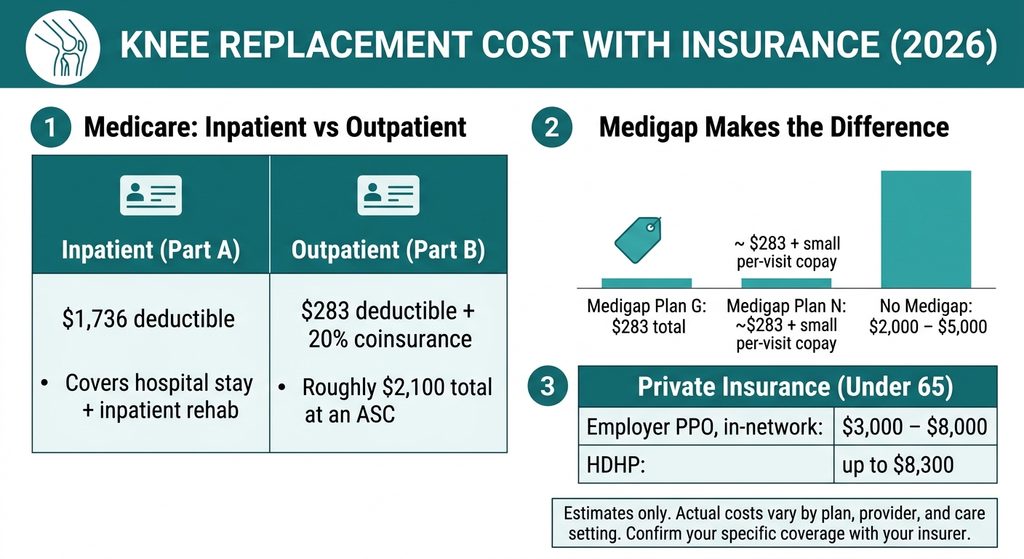
| Inpatient hospital stay | Part A | 2026 Part A deductible: $1,736 for the benefit period (covers the hospital stay and any inpatient rehab) |
| Outpatient (ASC or hospital outpatient) | Part B | 2026 Part B deductible ($283) plus 20% coinsurance; roughly $2,100 total at an ASC |
| Surgeon’s fee (either setting) | Part B | 20% coinsurance on the Medicare-approved surgeon fee, around $1,159 |
Since 2020, Medicare has allowed knee replacement in outpatient settings, and outpatient procedures often cost $10,000–$20,000 less than an inpatient hospital stay. That shift toward outpatient care has made Part B increasingly relevant for knee replacement, not just Part A.
Medigap: The Difference Between $283 and $5,000
A Medigap policy changes your knee replacement cost with insurance dramatically if you have Original Medicare:
- Medigap Plan G — covers the Part B coinsurance in full, leaving you responsible for only the Part B deductible (around $283). For an outpatient procedure, that can mean your total out-of-pocket cost is just the deductible.
- Medigap Plan N — covers most coinsurance but adds a small copay (commonly around $20) per visit, keeping your total slightly above the Plan G scenario.
- No Medigap — you owe the full 20% coinsurance with no annual cap under Original Medicare alone, which typically lands between $2,000 and $5,000 for a knee replacement once you include both the facility and surgeon portions.
Because Medigap’s effect on your total cost is so large, checking whether you have a supplement plan — and which letter plan specifically — matters more here than almost any other factor in this guide.
Medicare Advantage: A Different Cost Structure
Medicare Advantage plans cover knee replacement at least as well as Original Medicare, but they use a different cost-sharing structure. Instead of a flat coinsurance percentage, many plans charge a hospital copay of $100–$400 per day for the first several days of an inpatient stay. The advantage: your total costs are capped at your plan’s annual out-of-pocket maximum, so a complication-heavy recovery won’t expose you to unlimited cost-sharing the way Original Medicare alone can.
Calling the number on your insurance card and asking directly, “What will knee replacement surgery cost me?” is worth doing before scheduling, since Medicare Advantage plan details vary significantly.
Private Insurance: What Employer Plans Typically Cost
For patients under 65 with employer-sponsored insurance, knee replacement cost with insurance typically breaks down like this:
| Coverage situation | Typical out-of-pocket cost |
|---|---|
| Employer PPO plan, in-network | $3,000 – $8,000 |
| High-deductible health plan (HDHP) | Up to $8,300 (statutory out-of-pocket maximum) |
| Out-of-network surgeon or facility | Can double your share compared to in-network care |
Because out-of-network care can dramatically increase your cost, confirming that both your surgeon and facility are in-network — not just one or the other — protects you from a much larger bill than expected.
The American Academy of Orthopaedic Surgeons publishes patient guidance on when knee replacement is typically recommended, and the Centers for Medicare & Medicaid Services maintains current Medicare payment rates and coverage rules for the procedure.
Questions to Ask Before You Schedule
- Will my surgery be classified as inpatient or outpatient, and how does that change what I owe?
- Do I have a Medigap policy, and if so, which letter plan?
- Are both my surgeon and facility confirmed in-network under my specific plan?
- What’s my plan’s annual out-of-pocket maximum, and how close am I to it already this year?
- If I need a second knee replaced later, does that reset my deductible and out-of-pocket maximum?
Frequently Asked Questions
Why did my knee replacement cost so much less than a friend’s, even though we both have Medicare? The most common reason is Medigap. A patient with Medigap Plan G might pay only the Part B deductible, while a patient with no supplement pays the full 20% coinsurance with no annual cap.
Is outpatient knee replacement safe, or just cheaper? For appropriately selected candidates, outpatient total knee replacement is considered safe and has grown common since Medicare began allowing it in this setting in 2020. Your surgeon determines candidacy based on your specific health, not cost alone.
Does Medicare cover a second knee replacement if I already had one done? Yes, Medicare covers each medically necessary knee replacement separately, including a bilateral case done in two stages. Your deductible and cost-sharing typically apply again for the second procedure, depending on timing within your benefit period.
What’s the single biggest factor in knee replacement cost with insurance? For Medicare patients, it’s whether you have a Medigap policy. For patients with private insurance, it’s usually whether your surgeon and facility are in-network.
Sources and figures referenced in this guide come from 2026 CMS rate data and insurance-industry averages. This article doesn’t recommend any specific surgeon, hospital, or insurance plan. Confirm current pricing directly with your provider and insurer, and consult a board-certified orthopedic surgeon to determine whether surgery is right for you.