
Addiction treatment center cost varies enormously depending on facility type, not just level of care. A 30-day residential stay can cost $14,000 at a standard program or $100,000 at a luxury facility, even though both may offer the same evidence-based clinical treatment underneath. Understanding what that price difference actually buys — and what it doesn’t — matters more here than in almost any other treatment in this guide.
This guide compares addiction treatment center cost by type in 2026: standard, private, executive, and luxury facilities, plus specialty programs designed for specific populations.
This article is for general informational purposes only. It is not medical advice and does not replace an assessment by a licensed treatment provider. Figures are 2026 industry estimates based on published facility pricing. If you or someone you know needs help finding treatment, SAMHSA’s National Helpline (1-800-662-4357) offers free, confidential referrals 24/7.
Quick Answer
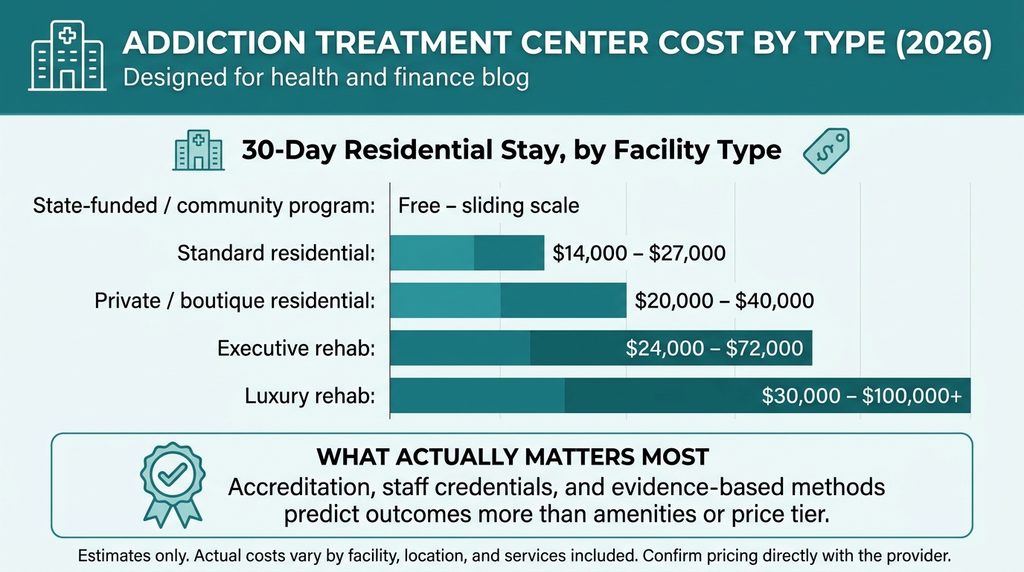
Addiction treatment center cost for a 30-day residential program ranges from free at state-funded programs to $100,000+ at luxury facilities. Standard residential treatment typically runs $14,000 to $27,000, private or boutique programs run $20,000 to $40,000, executive programs run $24,000 to $72,000, and luxury facilities run $30,000 to $100,000 or more.
Because the clinical treatment itself is often similar across these tiers, the price difference mainly reflects amenities, privacy, and staff-to-patient ratio — not necessarily better outcomes.
Addiction Treatment Center Cost by Facility Type
Here’s how a 30-day residential stay typically compares across facility types:
| Facility type | Typical 30-day cost | What the price typically adds |
|---|---|---|
| State-funded / community program | Free – sliding scale | Publicly funded slots for qualifying residents |
| Standard residential | $14,000 – $27,000 | Evidence-based clinical care, shared rooms, standard amenities |
| Private / boutique residential | $20,000 – $40,000 | Smaller facility, more individual attention, private or semi-private rooms |
| Executive rehab | $24,000 – $72,000 | Private offices, structured work access, discretion for professionals |
| Luxury rehab | $30,000 – $100,000+ | Resort-style setting, gourmet meals, spa amenities, high staff-to-patient ratio |
Because facility type and level of care are two separate variables, a luxury detox program and a standard inpatient program can sit at similar price points depending on exactly what each includes — always compare the full 30-day cost, not just a facility’s category label. For how level of care itself changes the price, see our guide to rehab treatment cost with vs without insurance.
Does a Higher Addiction Treatment Center Cost Mean Better Outcomes?
Not necessarily, and this is worth understanding clearly before choosing based on price alone. Luxury amenities — private rooms, gourmet nutrition, equine therapy, spa services — can make treatment more comfortable, and comfort does help some people engage more fully with treatment. But the clinical factors that actually drive outcomes are the same regardless of price tier:
- Accreditation from a recognized body, such as The Joint Commission or CARF
- Staff credentials, including licensed clinicians and appropriate medical supervision
- Evidence-based treatment methods, rather than unproven or alternative-only approaches
- Individualized treatment planning, tailored to your specific situation rather than a one-size-fits-all program
- Aftercare support and family involvement, since recovery extends well beyond the initial stay
A standard-priced facility that scores well on these five factors often serves a patient just as effectively as a luxury facility charging five times more. The extra cost at a luxury facility buys comfort and privacy, which matter to some patients, but it doesn’t automatically buy better clinical care.
Specialty Programs: Who They’re For and Why They Cost More
Some addiction treatment center cost increases come from serving a specific population rather than from luxury amenities:
- Dual diagnosis programs, treating substance use alongside a co-occurring mental health condition, typically run $10,000–$30,000 per month due to added psychiatric staff and integrated care.
- Programs for veterans, professionals, LGBTQ+ clients, or teens often include additional specialized clinical staff or population-specific programming, which can raise the price compared to a general program.
- Faith-based programs vary widely in cost, from free community-based options to full-price private facilities, depending on the organization running them.
Because these programs address specific clinical or personal needs, the added cost — when it exists — usually reflects genuinely different staffing and services, not just marketing positioning.
In-Network vs. Out-of-Network: A Bigger Factor Than Facility Type
For many patients, whether a facility is in-network with their insurance changes the out-of-pocket cost more than the facility type itself. An in-network standard residential program often costs a patient far less out of pocket than an out-of-network luxury facility, even before considering the sticker price difference. Always verify network status directly with both the facility and your insurer before committing, since this single detail can outweigh most other cost factors in this guide — including whether you choose inpatient or outpatient care in the first place.
The SAMHSA treatment locator lists both state-funded and private facilities alongside insurance information, and the National Institute on Drug Abuse (NIDA) publishes guidance on evaluating whether a specific program is evidence-based, regardless of price tier.
Questions to Ask Regardless of Facility Type
- Is this facility licensed by the state and accredited by a recognized body?
- What’s included in the quoted price, and what gets billed separately?
- Are you in-network with my insurance, and can you verify that in writing before I travel or check in?
- What are your staff’s credentials, and what’s your staff-to-patient ratio?
- What does aftercare and step-down support look like once the initial stay ends?
Frequently Asked Questions
Is luxury rehab worth the extra addiction treatment center cost? It depends on what you’re weighing it against. Luxury amenities can make treatment more comfortable and appealing to people who wouldn’t otherwise engage with treatment, but the core clinical factors that drive outcomes — accreditation, staff credentials, evidence-based methods — exist at standard-priced facilities too.
Does insurance cover any facility type equally? Insurance typically covers medically necessary treatment regardless of facility type, but many luxury and some executive facilities are out-of-network or don’t accept insurance at all, shifting most or all of the cost to self-pay. If a claim gets denied, see our guide on does insurance cover rehab treatment for how to appeal.
Are specialty programs (veterans, LGBTQ+, professionals) worth the added cost? For patients who benefit from population-specific programming or staff experience, yes — the added clinical value is often real, not just a marketing label. It’s worth asking specifically what makes the specialty program different clinically, not just demographically.
How do I know if a facility’s price is fair for what it offers? Ask for a full, itemized quote and compare it against the accreditation and staffing questions above. A facility confident in its clinical quality should answer these questions directly, regardless of which price tier it falls into.
Sources and figures referenced in this guide come from 2026 facility pricing data across the addiction treatment industry. This article doesn’t recommend any specific treatment facility. If you or someone you know is struggling with substance use, SAMHSA’s National Helpline (1-800-662-4357) provides free, confidential support and referrals 24/7.