
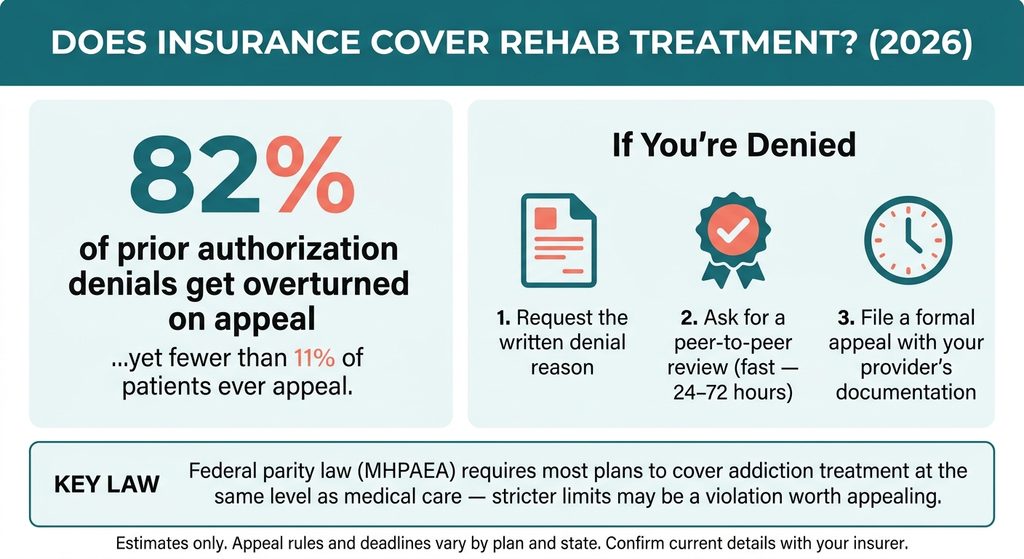
Does insurance cover rehab treatment? Legally, in most cases, yes — federal law requires it. But “covered by law” and “approved without a fight” are two different things, and a denial isn’t the end of the process the way it can feel in the moment. One statistic makes this especially clear: roughly 82% of prior authorization denials get overturned on appeal, yet fewer than 11% of patients ever file one.
This guide explains does insurance cover rehab treatment under federal parity law, why claims get denied anyway, and the specific appeal steps that give you the best odds of reversing a denial.
This article is for general informational purposes only. It is not legal or medical advice. Insurance rules and appeal deadlines vary by plan and state, and change over time. If you or someone you know needs help finding treatment, SAMHSA’s National Helpline (1-800-662-4357) offers free, confidential referrals 24/7.
Quick Answer
Yes, in most cases — the Mental Health Parity and Addiction Equity Act (MHPAEA) requires most health plans to cover substance use treatment at parity with medical and surgical care, and the Affordable Care Act makes it one of ten essential health benefits for many plans. But insurers still deny individual claims, most often citing “not medically necessary.” Few people appeal, yet appeals often succeed: according to KFF’s analysis of 2025 insurer data, 67% of appealed prior authorization denials were overturned in Medicare Advantage, 47% in Medicaid managed care and 43% in ACA Marketplace plans. These figures cover all types of care, not rehab specifically, but the message is clear: the process works, but only if you use it.
Because so few patients appeal despite these odds, understanding the appeal process matters as much as understanding what rehab treatment costs with vs without insurance in the first place.
This guide is for general information only and is not medical, legal, insurance or financial advice. Costs, coverage rules and interest rates change and vary by provider, plan and state. Always confirm details directly with your provider, insurer or lender before making a decision. If you or someone you know needs help with substance use, call the SAMHSA National Helpline at 1-800-662-4357 (free, confidential, 24/7).
What Federal Parity Law Actually Requires
Since 2008, MHPAEA has prohibited most health plans from applying stricter rules to addiction treatment than they apply to comparable medical care. Specifically, a plan generally cannot impose:
- Stricter day or visit limits on rehab than on a medical hospitalization of similar length
- Higher copays or coinsurance for addiction treatment than for comparable medical care
- More restrictive prior authorization or concurrent review requirements for substance use treatment than for medical conditions
Since 2021, under the Consolidated Appropriations Act, plans must also perform and document a “comparative analysis” for any limitation they apply to mental health and substance use benefits — and provide it to you on request. Few people know this right exists, but requesting that comparative analysis in writing is one of the most useful, underused tools available if you suspect your plan is applying stricter rules than parity law allows.
Why Claims Get Denied Anyway
Parity law doesn’t eliminate prior authorization or medical necessity review — it just requires those tools to apply evenly. “Not medically necessary” remains the most common reason insurers deny rehab claims. In practice, this usually means the insurer’s reviewer disagrees with your treatment team about which level of care you need, not that they dispute you need treatment at all. This disagreement can apply regardless of which type of facility you and your treatment team have chosen.
Coverage rules also vary by setting — see our breakdown of inpatient vs outpatient rehab cost for how these settings differ financially, not just in prior authorization requirements:
| Setting | Typical prior authorization requirement |
|---|---|
| Emergency detox | Often covered without prior approval |
| Residential/inpatient | Usually requires prior authorization |
| Outpatient and IOP | Often doesn’t require pre-authorization |
How to Appeal a Denial: The Real Process
If your claim gets denied, here’s the sequence that gives you the best chance of reversal:
- Request the written denial reason and the specific criterion applied. You’re entitled to know exactly why the claim was denied, not just that it was.
- Ask for a peer-to-peer review quickly. This is a direct clinical conversation between your treating physician and the insurer’s reviewing physician — often the fastest and most effective step, but the window can be as short as 24 to 72 hours after the denial, so speed matters.
- Get your provider’s ASAM Level of Care Assessment. This documentation, based on the six clinical dimensions used by the American Society of Addiction Medicine, is the strongest counter-evidence to a “not medically necessary” denial.
- File a formal internal appeal. Deadlines vary by plan, commonly ranging from 30 to 180 days from the denial — confirm your specific plan’s deadline immediately, since missing it can forfeit your right to appeal at that level.
- Request external review if the internal appeal fails. External review is often binding on the insurer, and expedited versions exist for urgent situations.
Self-Funded vs. Fully Insured: Why It Changes Who Can Help You
If you’re not sure which regulator oversees your specific appeal, ask your HR department one direct question: is our health plan self-funded or fully insured? The answer determines which agency has jurisdiction over your parity complaint and appeal, which matters if your internal and external appeals within the plan don’t resolve the issue.
The US Department of Labor oversees MHPAEA compliance for many private employer plans, and the SAMHSA treatment locator lists treatment options along with general insurance guidance.
Questions to Ask Your Insurer Before and After a Denial
- What specific criteria did you use to determine this treatment wasn’t medically necessary?
- Can you provide the comparative analysis showing how this limitation compares to your medical/surgical benefit?
- What’s my exact deadline to file an internal appeal, and is expedited review available given my situation?
- Can my treating physician schedule a peer-to-peer review, and how quickly?
- If my internal appeal fails, what’s the process and deadline for external review?
Frequently Asked Questions
Does insurance cover rehab treatment the same way in every state? Federal parity law sets a floor that applies broadly, but some states add additional protections on top. Checking your specific state’s insurance department for any state-level parity enhancements is worth doing alongside the federal rules.
Is it worth appealing if the facility said insurance denied the claim? Yes — given that roughly 82% of prior authorization denials get overturned on appeal, treating an initial denial as final skips a step that succeeds far more often than most people realize.
What if I don’t have time to wait for a standard appeal? Expedited or urgent appeal processes exist specifically for situations where a standard timeline could risk your health — ask your insurer directly about expedited review if your situation is time-sensitive.
Does COBRA coverage carry the same parity protections? Yes. COBRA continuation coverage maintains your existing plan’s benefits, including MHPAEA parity protections, for the duration of your COBRA eligibility.
Sources and figures referenced in this guide come from 2026 published legal and insurance-industry data on MHPAEA parity enforcement and appeal outcomes. This article doesn’t recommend any specific insurer, attorney, or treatment facility. If you or someone you know is struggling with substance use, SAMHSA’s National Helpline (1-800-662-4357) provides free, confidential support and referrals 24/7.