
Surrogacy cost breakdown surprises a lot of intended parents. The headline number quoted by an agency is rarely the final number. A full US gestational surrogacy journey typically runs $100,000 to $220,000. That total comes from several separate categories — surrogate compensation, agency fees, medical care, and legal work — and each provider bills on its own timeline.
This guide breaks down surrogacy cost in 2026, line by line. It explains why state law changes your total more than almost any other factor in this guide, and covers what a quote typically does and doesn’t include.
This article is for general informational purposes only. It is not legal or medical advice. Surrogacy law varies dramatically by state and country, and compensated surrogacy is restricted or unclear in some US states. Consult a licensed reproductive law attorney in your specific state before beginning any surrogacy arrangement. Figures are 2026 industry estimates based on published agency and legal-services data.
Quick Answer
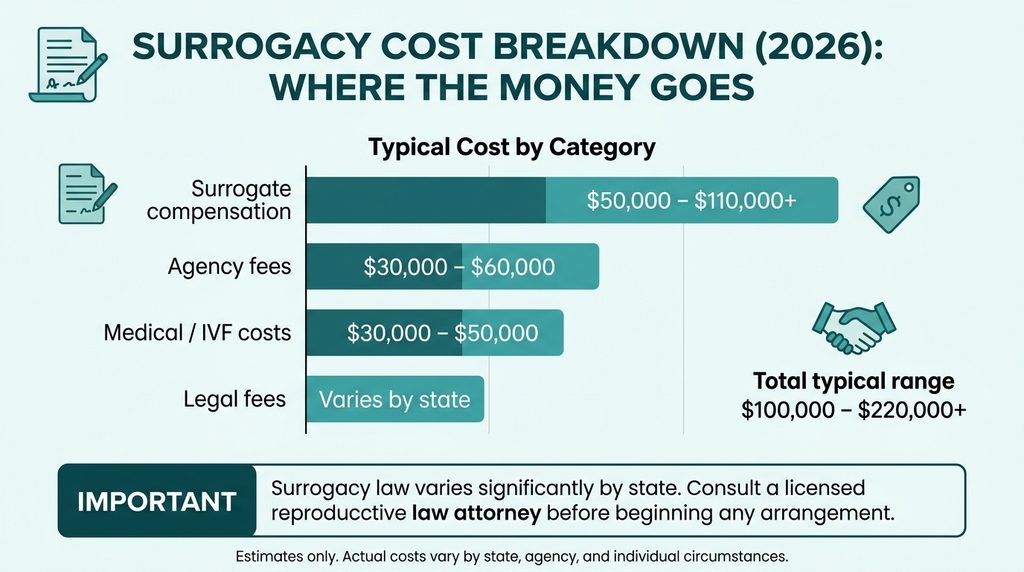
A full US surrogacy journey typically costs $100,000 to $220,000, with complex cases involving donor eggs or a live birth guarantee reaching $250,000 to $300,000. Surrogate compensation is usually the single largest line item, commonly $50,000 to $110,000+, followed by agency fees ($30,000–$60,000) and medical/IVF costs ($30,000–$50,000).
Because these categories come from different providers on different timelines, a single “starting at” number from any one source rarely reflects your full budget.
Surrogacy Cost Breakdown by Category
| Category | Typical cost | What it covers |
|---|---|---|
| Surrogate compensation | $50,000 – $110,000+ | Base compensation, monthly allowances, and milestone payments to the gestational carrier |
| Agency fees | $30,000 – $60,000 | Matching, case management, and coordination between all parties |
| Medical / IVF costs | $30,000 – $50,000 | Embryo creation or transfer, prenatal care, and delivery-related medical expenses |
| Legal fees | Varies by state and complexity | Contracts between intended parents and surrogate, parentage documentation |
| Egg donation (if needed) | $18,000 – $65,000+ | Separate from surrogacy itself — see our donor egg IVF cost guide for detail |
Surrogate compensation reflects months of physical commitment and medical involvement — typically 12 to 18 months from matching through delivery. Because of that, agencies rarely reduce this category, regardless of which program you choose.
Why State Law Changes Your Total More Than Almost Anything Else
This is the detail most cost breakdowns underemphasize: surrogacy law varies enormously by US state. That variation affects whether compensated surrogacy is legally straightforward, and it affects how much the arrangement typically costs.
- States with clear, surrogacy-friendly laws (such as California) often see higher surrogate compensation and agency demand, which pushes total costs toward the higher end of the range, sometimes exceeding $200,000.
- States with restrictive or unclear laws on compensated gestational surrogacy make the arrangement more legally complicated, and in some cases not a viable option at all — this varies enough that a state-specific legal consultation is essential before proceeding, not optional.
- Where your surrogate lives matters as much as where you live, since her state’s law governs significant parts of the legal process.
Because of this legal variation, the very first step in any surrogacy budget should be a consultation with a reproductive law attorney licensed in the relevant state — before signing an agency contract, not after. The Academy of Adoption and Assisted Reproduction Attorneys maintains a directory of vetted attorneys who specialize in this exact area of law.
Agency vs. Independent Surrogacy
Working with an agency versus arranging surrogacy independently changes your cost structure significantly:
- Agency-assisted surrogacy provides matching, screening, and case management, for a fee typically between $30,000 and $60,000. Some agencies use a “no match, no fee” model, charging only once a match is confirmed.
- Independent surrogacy — arranging a match without an agency, often with someone already known to the intended parents — can reduce costs by an estimated $20,000 to $49,000. In exchange, intended parents take on the coordination, screening, and risk-management work an agency would otherwise handle.
Independent surrogacy shifts real responsibility, not just cost, onto intended parents. So this trade-off is worth weighing carefully alongside the savings, not treated as a simple discount.
A Note on International Surrogacy
Some intended parents look outside the US for lower costs. This guide intentionally doesn’t provide destination-specific pricing. International surrogacy involves serious, country-specific legal complexity — including whether the arrangement holds up legally at all, and whether the US will recognize resulting parentage upon return. Specialized legal counsel, not cost comparison, should drive this decision. The American Society for Reproductive Medicine publishes ethics guidance on third-party reproduction that’s worth reviewing alongside legal advice.
Questions to Ask Before You Begin
- Has a reproductive law attorney in the relevant state confirmed this arrangement is legally sound before I sign anything?
- What does the agency fee specifically include, and what’s billed separately?
- What’s the full payment schedule and timeline, not just the total?
- What happens financially if a match doesn’t work out, or if a pregnancy doesn’t proceed as planned?
- Does this quote include a live birth guarantee, or additional transfer attempts if needed?
Frequently Asked Questions
Why is surrogate compensation the largest cost category? It reflects the surrogate’s sustained physical commitment and medical involvement over 12 to 18 months, not a simple service fee. Most guidance treats it as compensation for time and health-related commitment, not a negotiable line item to minimize.
Is surrogacy legal everywhere in the US? No. Laws vary significantly by state, and compensated gestational surrogacy is more legally straightforward in some states than others. This is a legal question to resolve with a licensed attorney before proceeding, not something to assume based on general information.
Can grants or financing reduce surrogacy cost? Some intended parents use fertility-specific loans, employer fertility benefits, or grants to help cover costs, similar to financing options used for IVF. Given the scale of surrogacy costs, financial planning early in the process matters more here than in most other treatments in this guide. See our fertility grants and financial assistance guide for the major programs available.
Does surrogacy cost breakdown include the egg donation process? Not by default — egg or sperm donation, if needed, is typically a separate cost added on top of the core surrogacy budget, since not every journey requires donor gametes.
Sources and figures referenced in this guide come from 2026 agency and legal-services industry data. This article doesn’t recommend any specific agency, attorney, or country. Consult a licensed reproductive law attorney in your specific state and a fertility specialist before beginning a surrogacy arrangement.