
Donor egg IVF cost splits into two categories that work very differently: fresh donor cycles, which coordinate a living donor’s medical cycle in real time, and frozen donor egg cohorts, which are already retrieved and stored, ready to ship to your clinic. That structural difference drives a large part of the price gap between the two.
This guide breaks down donor egg IVF cost in 2026 for both fresh and frozen paths, what each quote typically leaves out, and how success rates factor into the real cost-per-outcome comparison. See our IVF cost without insurance guide for the standard own-egg process, or surrogacy cost breakdown if you’re exploring that path as well.
This article is for general informational purposes only. It is not medical advice and does not replace a consultation with a fertility specialist. Figures are 2026 industry estimates based on published egg bank, agency, and clinic pricing. Ask your specific provider for a full, written, itemized quote before proceeding.
Quick Answer
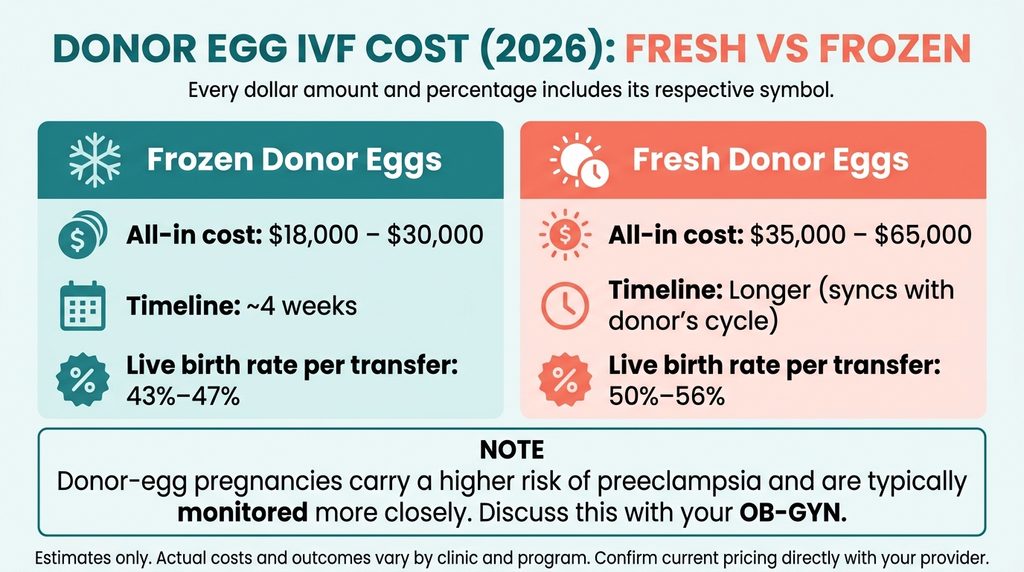
Donor egg IVF cost using a frozen donor egg cohort typically runs $18,000 to $30,000 all-in, with some lower-cost programs starting closer to $11,500–$15,000. A fresh donor cycle typically costs $35,000 to $65,000, since it requires coordinating a donor’s full medical cycle rather than shipping already-frozen eggs.
Both paths cost significantly more than standard IVF using your own eggs, but both also come with meaningfully higher success rates — often described as up to three times higher for women over 40.
Donor Egg IVF Cost: Fresh vs Frozen
| Factor | Frozen donor eggs | Fresh donor eggs |
|---|---|---|
| Typical all-in cost | $18,000 – $30,000 | $35,000 – $65,000 |
| What drives the cost | Egg-bank cohort fee, clinic IVF/lab fees | Donor compensation, travel, medical coordination, clinic fees |
| Timeline | About 4 weeks from selection to transfer | Longer — requires syncing with the donor’s cycle |
| Live birth rate (per transfer) | ~43% – 47% | ~50% – 56% |
Frozen eggs cost less mainly because you’re purchasing eggs that already exist in a bank’s inventory, rather than commissioning and coordinating a donor’s stimulation cycle in real time.
What Actually Makes Up Donor Egg IVF Cost
A donor egg quote usually separates into donor-side costs and clinic-side costs, billed by two different parties:
| Component | Typical cost |
|---|---|
| Frozen egg cohort (6–8 eggs) | $12,000 – $30,000 |
| Fresh donor compensation | $8,000 – $30,000+ (rare cases exceed $100,000 for high-demand donor profiles) |
| Clinic IVF/embryology fees | $5,000 – $10,000 |
| Recipient medications | $3,000 – $6,000 |
| PGT-A genetic testing (optional) | $3,000 – $6,000 |
| Legal contract | $1,500 – $3,500 |
| Donor travel (fresh cycles, if out-of-state) | $2,000 – $5,000 (under $1,000 if local) |
Because donor-side and clinic-side costs come from different sources, a single “starting at” number rarely reflects your full total — always ask for both pieces before comparing two programs.
Why Success Rates Change the Real Comparison
Donor egg IVF cost looks steep next to standard IVF, but success rates tell a more complete story. National data shows fresh donor eggs resulting in a live birth in roughly 50–56% of transfers, and frozen donor eggs in roughly 43–47% — both dramatically higher than typical success rates using a patient’s own eggs, particularly for women over 40 with diminished ovarian reserve.
Some well-established programs report cumulative live birth rates approaching very high percentages after three transfers, though this varies significantly by program and individual circumstances — a number worth verifying with your specific clinic’s own outcome data rather than relying on any single published figure.
A Medical Note Worth Knowing
Donor-egg pregnancies carry an estimated three-times-higher risk of preeclampsia compared to pregnancies using a patient’s own eggs, according to meta-analyses on the topic. Because of this, clinics typically monitor donor-egg pregnancies as higher-risk, with more frequent prenatal surveillance. This is a clinical conversation to have directly with your OB-GYN and fertility team, not a reason to avoid donor eggs — but it’s a real factor worth understanding as part of your overall decision, not just the cost side.
International Options: A Lower-Cost Alternative
Donor egg IVF cost outside the US runs considerably lower in some regions — commonly $8,000 to $14,000 in parts of Europe, compared to $35,000–$65,000 for a fresh cycle domestically. As with other treatments in this guide, lower international pricing often reflects lower local costs rather than lower quality, but it adds travel, legal, and follow-up-care considerations worth researching as carefully as the price difference itself.
The American Society for Reproductive Medicine and the Society for Assisted Reproductive Technology both publish guidance comparing fresh and frozen donor egg outcomes, independent of any single clinic or egg bank.
Questions to Ask Before You Choose a Program
- Is this quote for the donor-side cost, the clinic-side cost, or the full all-in total?
- What’s included if the first transfer doesn’t result in a pregnancy — do you offer a multi-transfer guarantee program?
- How many eggs or embryos will I have available after this cycle, and what does additional storage cost afterward?
- What are your clinic’s actual live birth rates for donor egg cycles, not just the national average?
- If I choose a fresh cycle, what happens financially if the donor’s cycle needs to be cancelled or adjusted?
Frequently Asked Questions
Is frozen donor egg IVF cost always cheaper than fresh? In nearly all cases, yes, mainly because frozen eggs skip the real-time medical coordination, travel, and higher donor compensation that fresh cycles typically involve.
Do frozen donor eggs work as well as fresh ones? Success rates are close, with fresh cycles running somewhat higher per transfer. ASRM guidance notes the two paths produce broadly comparable results, so the choice often comes down to cost, timeline, and donor availability rather than a large success-rate gap.
Does insurance ever cover donor egg IVF cost? Rarely, and coverage depends heavily on your state’s fertility mandate and whether your employer plan is self-funded — the same coverage factors that apply to standard IVF also apply here, though donor-specific costs are even less commonly covered.
How many embryos do I typically get from a donor egg cycle? It varies by cohort size and individual response, but many patients get enough embryos for more than one transfer attempt, which is worth discussing upfront since it affects your total cost-per-child if you plan to have more than one.
Sources and figures referenced in this guide come from 2026 egg bank, agency, and clinic pricing data, along with published success-rate research. This article doesn’t recommend any specific clinic, egg bank, or agency. Confirm current pricing directly with a provider, and consult a reproductive endocrinologist to discuss whether donor eggs fit your situation.