
Breast augmentation cost depends heavily on implant type, but that’s only part of the picture. The number most often quoted online — the American Society of Plastic Surgeons’ reported average surgeon fee of $4,875 — only covers the surgeon’s own charge. Anesthesia, facility fees, and the implants themselves get added on top, so the real out-of-pocket total runs considerably higher.
This guide breaks down breast augmentation cost in 2026 by implant type, what a full quote actually includes, and the rare cases where insurance helps cover it. If you’re planning a broader body-contouring plan, our liposuction cost by body area and tummy tuck cost guides cover common combination procedures.
This article is for general informational purposes only. It is not medical advice and does not replace a consultation with a board-certified plastic surgeon. Figures are 2026 industry estimates based on published clinic pricing and American Society of Plastic Surgeons data. Ask your provider for a full, all-inclusive quote before scheduling surgery.
Quick Answer
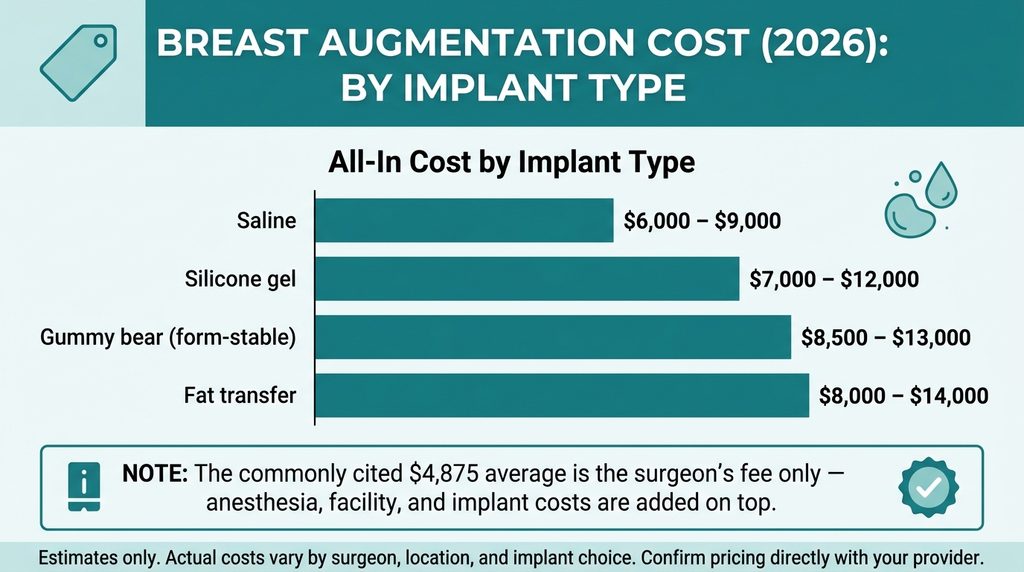
Breast augmentation cost typically runs $6,000 to $15,000 all-in, with a national average around $8,500. Saline implants land at the lower end, generally $6,000 to $9,000, silicone gel implants run $7,000 to $12,000, and premium “gummy bear” form-stable implants run $8,500 to $13,000.
Because the widely cited $4,875 figure is a surgeon’s-fee-only average, always ask for the complete, all-inclusive total before comparing two clinics’ prices.
Breast Augmentation Cost by Implant Type
| Implant type | Typical all-in cost | Implant material cost alone (per pair) |
|---|---|---|
| Saline | $6,000 – $9,000 | $800 – $1,500 |
| Silicone gel | $7,000 – $12,000 | $1,800 – $2,500 |
| Gummy bear (form-stable silicone) | $8,500 – $13,000 | $2,500 – $3,500 |
| Fat transfer (no implants, uses your own fat) | $8,000 – $14,000 | Not applicable — combines liposuction and transfer in one session |
Silicone implants generally cost $1,000 to $2,500 more than saline, mainly because of their more complex manufacturing and the more natural feel many patients and surgeons prefer. Fat transfer augmentation costs more than either implant option in many cases, since it actually combines two procedures — liposuction and the transfer itself — into a single session.
What a Full Quote Actually Includes
A breast augmentation quote can bundle several pieces together, or list them separately depending on the practice:
- Surgeon’s fee
- Implant pair (saline, silicone, or gummy bear)
- Anesthesia professional’s fee
- Surgical facility or operating room charge
- Pre-operative lab work and any required medical clearance
- Post-operative surgical bra or compression garment
- Follow-up appointments
Because some practices quote only the surgeon’s fee while others quote a true all-inclusive price, a $3,900 “starting at” number and a $7,000 all-inclusive number might actually represent the same real total once every piece gets added in. Always ask directly whether a quote is all-inclusive before comparing it to another clinic’s price.
Breast Augmentation Cost by Location
Where you have surgery changes breast augmentation cost by a meaningful margin. States with a lower cost of living — Ohio, Tennessee, Alabama, and Texas among them — average $5,500 to $7,500, sometimes lower in rural areas within those states. Major metros like Los Angeles, New York City, and Miami typically run $2,000 to $5,000 higher than the same procedure in a smaller market, largely due to overhead, real estate costs, and local demand.
Because a lower price shouldn’t come at the expense of surgeon qualifications, prioritize a board-certified plastic surgeon over the cheapest available quote, regardless of which state you’re in.
Does Insurance Cover Breast Augmentation Cost?
Almost never for cosmetic augmentation. Insurance treats a purely aesthetic breast augmentation as elective, so it’s excluded from coverage. That said, real exceptions exist:
- Breast reconstruction after mastectomy is federally mandated for coverage under the Women’s Health and Cancer Rights Act, regardless of which insurer you have.
- Significant congenital asymmetry or developmental conditions, such as Poland syndrome, sometimes qualify for coverage when a physician documents medical necessity.
Because these exceptions require specific documentation, verifying eligibility with your insurer before scheduling is worth doing if your situation might qualify, rather than assuming coverage is impossible.
The Long-Term Cost Most Quotes Don’t Mention
Breast implants aren’t lifetime devices. Most patients should expect to need a replacement or revision within 10 to 20 years, whether due to normal wear, a desired size change, or (rarely) implant rupture. Because this eventual cost repeats the anesthesia and facility fees on top of a new implant pair, it’s worth factoring a future revision into your long-term financial picture, not just the initial procedure price.
The American Society of Plastic Surgeons publishes current surgeon-fee data and patient safety guidance, and the American Board of Plastic Surgery lets you verify whether a specific surgeon holds board certification.
Questions to Ask Before You Book
- Is this quote all-inclusive, or does it cover only the surgeon’s fee?
- Which implant type are we discussing, and how does the price change between saline, silicone, and gummy bear?
- Are you board-certified by the American Board of Plastic Surgery?
- What’s your revision policy if I need an adjustment within the first year?
- How does implant size affect the total price at your practice?
Frequently Asked Questions
Why do breast augmentation cost quotes vary so much online? Mostly because sources report different things — some cite the surgeon’s fee alone (like the ASPS’s $4,875 average), while others cite the full all-inclusive total. Always confirm which number you’re looking at before comparing sources.
Is silicone always more expensive than saline? Generally, yes, though the gap is smaller than many patients expect — commonly $1,000 to $2,500 depending on the specific implant. Many patients still choose silicone despite the premium, largely for its feel and lower visible rippling.
Does implant size change the price? At some practices, yes, since larger or more specialized implants can require additional materials. Other practices charge a flat rate regardless of size. Ask directly, since this varies by provider.
Is a very low advertised price a red flag? Not automatically, but it’s worth confirming what’s included. A price advertised near $2,900–$3,900 is very likely for saline implants and the surgeon’s fee alone, not the full all-inclusive total most patients actually pay.
Sources and pricing benchmarks referenced in this guide come from 2026 clinic pricing and American Society of Plastic Surgeons data. This article doesn’t recommend any specific surgeon or clinic. Confirm current pricing directly with a provider, and consult a board-certified plastic surgeon to determine which implant type fits your goals.