
Rhinoplasty cost splits along one key line: why you’re having the surgery. Purely cosmetic reshaping is never covered by insurance, but functional rhinoplasty — correcting a breathing problem like a deviated septum — can qualify for partial coverage. Many patients don’t realize that combining both goals in one surgery can meaningfully lower their out-of-pocket total, not just their number of procedures.
This guide breaks down rhinoplasty cost in 2026 by type, how the combination procedure works when insurance covers part of it, and what a full quote actually includes. For another procedure with its own insurance nuances, see our breast augmentation cost guide.
This article is for general informational purposes only. It is not medical advice and does not replace a consultation with a board-certified facial plastic surgeon or ENT. Figures are 2026 industry estimates based on published clinic pricing and American Society of Plastic Surgeons data. Ask your provider for a full, all-inclusive quote before scheduling surgery.
Quick Answer
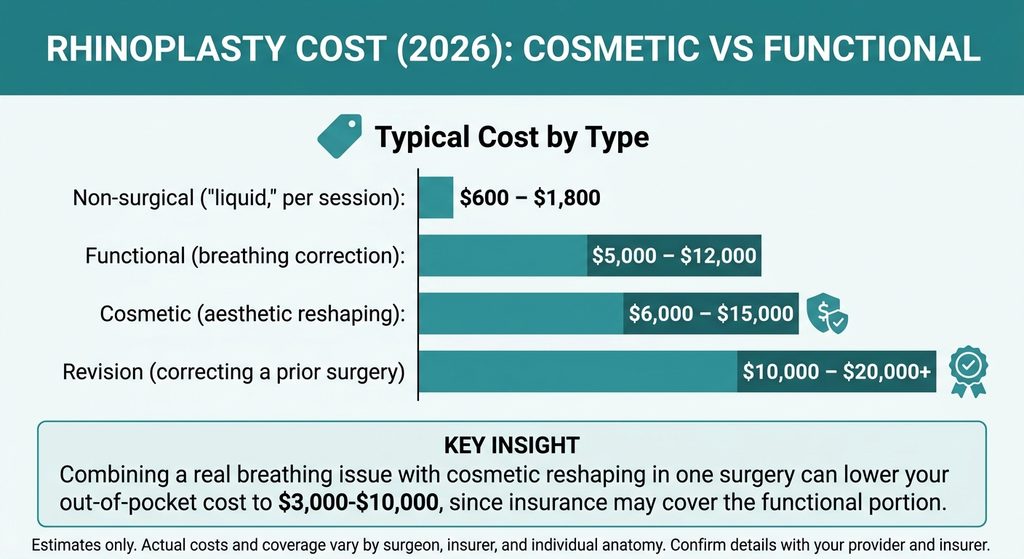
Cosmetic rhinoplasty cost typically runs $6,000 to $15,000 all-in, with a widely cited surgeon’s-fee-only average around $7,637 according to ASPS. Functional rhinoplasty (correcting a breathing problem) runs $5,000 to $12,000 and may be partially covered by insurance. Revision rhinoplasty, correcting a previous surgery, typically costs the most: $10,000 to $20,000 or more.
Because insurance coverage depends entirely on medical necessity, confirming which category your case falls into matters more here than almost any other factor.
Rhinoplasty Cost by Type
| Type | Typical cost | Insurance coverage |
|---|---|---|
| Cosmetic (aesthetic reshaping only) | $6,000 – $15,000 | Not covered |
| Functional (deviated septum, breathing obstruction) | $5,000 – $12,000 | May be partially covered when medically necessary |
| Revision (correcting a prior rhinoplasty) | $10,000 – $20,000+ | Depends on whether the revision addresses a functional issue |
| Non-surgical (“liquid rhinoplasty” using filler) | $600 – $1,800 per session | Not covered; temporary results only |
Revision rhinoplasty costs the most largely because it requires more surgical time and precision to work with existing scar tissue and altered anatomy — not simply because it’s a second procedure.
The Combination Procedure: How Insurance Can Lower Your Bill
This is the detail most rhinoplasty cost guides underexplain. When a patient has both a genuine breathing problem (commonly a deviated septum) and wants cosmetic reshaping, a surgeon can often perform both in a single combined surgery — sometimes called septorhinoplasty.
Here’s how the cost splits in that scenario:
- An ENT or plastic surgeon documents medical necessity for the functional issue (not a minor deviation, but one that measurably reduces airflow or causes recurrent problems)
- Your insurer pre-authorizes the functional portion
- Insurance covers the operating room, anesthesia, and facility fees tied to the septum correction
- You pay out of pocket only for the additional cosmetic reshaping — commonly $3,000 to $10,000, instead of the full $8,000–$12,000+ a purely cosmetic case would cost
Because this combination can meaningfully reduce your total, it’s worth discussing directly with your surgeon and ENT whether your anatomy includes a genuine functional component — not to manufacture a diagnosis, but because many patients with real breathing issues don’t realize surgery could address both at once.
What a Full Rhinoplasty Quote Actually Includes
An all-in quote should cover three components, which together typically make up 90–95% of the total: the surgeon’s fee, the anesthesiologist’s fee, and the surgical facility charge. What’s usually not included:
- Consultation fee ($100–$300, sometimes credited toward the surgery if you proceed)
- Pre-operative lab work
- Post-operative prescription medications
- Follow-up visits and splint removal (sometimes bundled, sometimes billed separately)
Because these smaller add-ons can shift the real total by several hundred dollars, ask for a complete, itemized breakdown rather than assuming the headline number is the final price.
Rhinoplasty Cost by Location
Geography changes rhinoplasty cost significantly. Surgeons in high-demand coastal markets — particularly Los Angeles, New York, and similar premium metros — often charge 30–50% more than surgeons in other regions, with total costs sometimes reaching $18,000–$30,000+ for complex cosmetic cases. Texas, by contrast, averages closer to $8,200–$12,800 for a comparable procedure, often without compromising surgeon quality.
Because rhinoplasty results are highly dependent on surgeon skill and experience, choosing based on location savings alone carries more risk here than in many other procedures — a surgeon’s rhinoplasty-specific portfolio matters more than their general reputation.
Questions to Ask Before You Book
- Is my case purely cosmetic, or does it include a genuine functional component worth discussing with an ENT?
- Does this quote include the surgeon’s fee, anesthesia, and facility charge, or are those separate?
- How many rhinoplasty procedures have you personally performed, and can I see examples similar to my anatomy?
- If insurance covers part of a combination procedure, what will my exact out-of-pocket portion be?
- What’s your revision policy if I’m not satisfied with the aesthetic result after healing?
The American Society of Plastic Surgeons publishes current surgeon-fee data, and the American Academy of Facial Plastic and Reconstructive Surgery offers a directory of surgeons specializing specifically in facial procedures like rhinoplasty.
Frequently Asked Questions
Why does rhinoplasty cost vary so much between sources online? Mainly because different sources report different numbers — some cite the surgeon’s fee alone (like ASPS’s average), others cite patient-reported all-in totals, which run considerably higher once anesthesia and facility fees are added.
Does a deviated septum always qualify for insurance coverage? Not automatically. Insurers generally require documented evidence that the deviation meaningfully impairs breathing — chronic congestion, recurrent sinusitis, or measurably reduced airflow — not just a slight anatomical deviation visible on imaging.
Is liquid rhinoplasty a good alternative to save money? It costs far less per session, but results are temporary (commonly lasting months, not years) and it can’t correct breathing problems the way surgical rhinoplasty can. It suits minor cosmetic adjustments rather than as a lower-cost substitute for surgery.
Is revision rhinoplasty always more expensive than a first surgery? Typically, yes, since operating on previously altered anatomy and scar tissue takes more surgical time and skill than an original procedure — a cost driver independent of whether the revision includes any functional component.
Sources and pricing benchmarks referenced in this guide come from 2026 clinic pricing and American Society of Plastic Surgeons data. This article doesn’t recommend any specific surgeon or clinic. Confirm current pricing directly with a provider, and consult a board-certified facial plastic surgeon or ENT to determine whether your case includes a functional component.