
Does insurance cover LASIK? For the overwhelming majority of patients, the answer is no — private insurance, Medicare, Medicaid, and even TRICARE all classify LASIK as an elective, cosmetic procedure. But one specific group can actually get LASIK completely free, and most people in that group don’t realize it applies to them.
This guide breaks down does insurance cover LASIK by coverage type, the narrow medical-necessity exceptions that exist, and the specific military program that provides free LASIK to eligible service members. For the full pricing picture if you end up paying out of pocket, see our LASIK eye surgery cost guide.
This article is for general informational purposes only. It is not medical or insurance advice. Figures and coverage rules are 2026 estimates based on published insurer and TRICARE information, which changes over time. Confirm current coverage directly with your specific insurer or military treatment facility.
Quick Answer
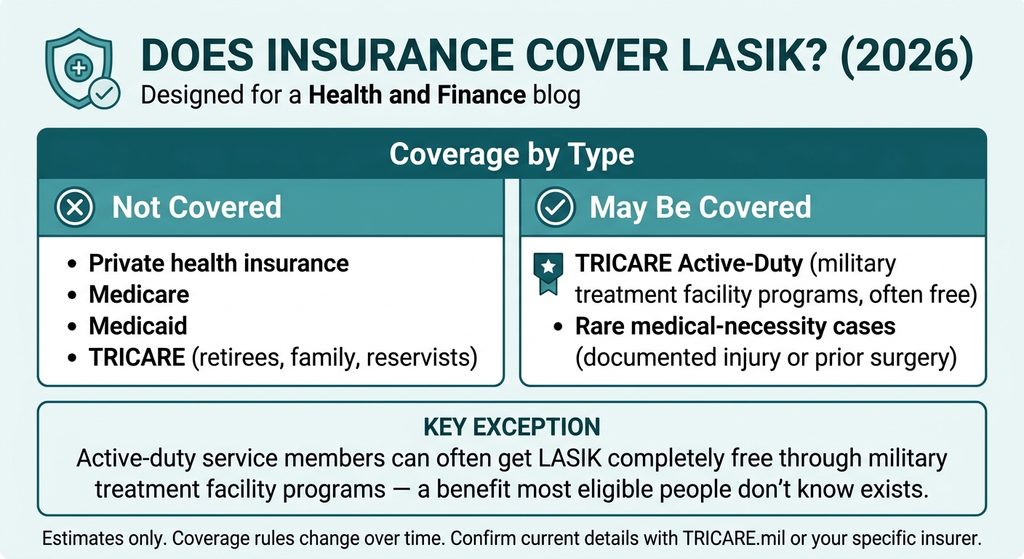
For nearly everyone, the answer to does insurance cover LASIK is no. Private health insurance, Medicare, Medicaid, and TRICARE all classify LASIK as elective and cosmetic, so none of them cover it as a standard benefit. The one major exception: active-duty service members can often get LASIK entirely free through military treatment facility refractive surgery programs, provided it supports their operational readiness.
Outside that specific group, rare medical-necessity exceptions exist — but they require substantial documentation and aren’t something most patients can count on.
Does Insurance Cover LASIK, by Type
| Coverage type | Does it cover LASIK? |
|---|---|
| Private health insurance (PPO, HMO) | No — classified as elective/cosmetic |
| Medicare | No |
| Medicaid | No |
| TRICARE (retirees, family members, reservists) | No, except rare documented medical necessity |
| TRICARE (active-duty service members) | Often yes, free, through military treatment facility programs — see below |
| FEDVIP (federal employee vision insurance) | No, but available as a separate purchased benefit for other vision needs |
The Exception Most People Don’t Know About: Free LASIK for Active-Duty Military
This is the detail that changes the “does insurance cover LASIK” answer for one specific group. Active-duty service members can often receive LASIK entirely free through military treatment facility (MTF) refractive surgery programs, sometimes referred to as the Warfighter Refractive Eye Surgery Program. The logic: eliminating dependence on glasses or contacts can directly support operational readiness and mission effectiveness, which qualifies it as a legitimate military medical benefit rather than a purely cosmetic choice.
Eligibility depends on:
- Active-duty status specifically — retirees, reservists, and family members generally don’t qualify for this free benefit
- Meeting specific medical and vision criteria (stable prescription, adequate corneal thickness, no active eye disease)
- Availability at a specific military treatment facility, which varies by base and branch
- Sometimes a waitlist, since demand can exceed program capacity at a given facility
If you’re active-duty and interested, the right first step is asking your military treatment facility directly about their refractive surgery program, rather than assuming it’s unavailable.
Rare Medical-Necessity Exceptions (Non-Military)
Outside the military program, insurance — including TRICARE for non-active-duty beneficiaries — may cover LASIK or a related refractive procedure only in narrow, well-documented cases:
- Severe refractive error confirmed by a licensed professional as significant enough to qualify
- Vision problems caused by an injury or a previous surgical procedure, where LASIK corrects a complication rather than simply reducing dependence on glasses
- A physical limitation that prevents wearing glasses or contact lenses, documented by a physician
These exceptions require real documentation and a case-by-case review — they aren’t something to expect by default, and insurers evaluate them individually rather than through a standard approval process.
What TRICARE Beneficiaries Without Active-Duty Status Should Expect
If you’re a TRICARE retiree, family member, or reservist, plan on paying out of pocket through a civilian provider. Costs typically run $2,000 to $4,500 per eye, depending on technology and region — the same range as the general civilian market. FEDVIP, a separate vision insurance program available to many TRICARE beneficiaries, doesn’t cover LASIK either, but it’s worth knowing about for other vision needs like glasses and contact lens fittings.
Real Ways to Lower LASIK Cost Without Insurance Coverage
Since the answer to does insurance cover LASIK is “no” for most people, these options matter more than pursuing coverage:
- HSA and FSA funds cover LASIK as an eligible medical expense regardless of insurance coverage, effectively discounting the cost by your marginal tax rate.
- In-network surgeon discounts. Even though the procedure itself isn’t covered, some insurance carriers negotiate discounted cash rates with specific in-network surgeons — worth asking your insurer directly.
- Employer vision plan discounts, where available, sometimes reduce the price by 10% to 20% at partner providers.
- Financing plans through CareCredit, Alphaeon Credit, or in-house payment options commonly offer 0% APR for 12 to 24 months.
The TRICARE website maintains current, official rules on LASIK coverage and the refractive surgery program for active-duty members, and the American Academy of Ophthalmology publishes general patient guidance on LASIK candidacy and cost. If LASIK doesn’t fit your candidacy, our PRK vs LASIK cost and SMILE eye surgery cost guides cover the alternatives, which follow the same general insurance rules.
Questions to Ask Before You Assume You’re Not Covered
- If you’re active-duty military: does your specific base or branch’s military treatment facility offer a refractive surgery program, and what’s the current waitlist?
- If you’ve had a prior eye injury or surgery: does your case meet the documentation threshold for a medical-necessity exception?
- Does your insurer offer an in-network discount on LASIK, even without full coverage?
- Does your employer’s vision plan include any laser vision correction discount?
Frequently Asked Questions
Does insurance cover LASIK for astigmatism specifically? No more than for standard nearsightedness or farsightedness — astigmatism correction via LASIK is still classified as elective by nearly all insurers, regardless of which refractive error it addresses.
Can veterans get free LASIK the same way active-duty members can? Generally, no. Military treatment facility refractive surgery programs are typically limited to active-duty service members specifically, not veterans or retirees, though eligibility details can vary by branch and should be confirmed directly.
Does insurance ever cover LASIK if my job requires good vision without corrective lenses? Standard civilian insurance doesn’t make exceptions based on job requirements. This consideration mainly applies within the military’s own operational-readiness framework, not civilian employer-sponsored insurance.
If insurance won’t cover LASIK, is it still worth checking with my insurer? Yes — even without full coverage, some insurers offer negotiated discount rates with specific in-network surgeons, which can meaningfully lower your out-of-pocket cost without full coverage.
Sources and coverage rules referenced in this guide come from 2026 TRICARE and insurance-industry published information. This article doesn’t recommend any specific insurer, provider, or military treatment facility. Confirm current coverage rules directly with TRICARE.mil or your specific insurer, and consult a licensed ophthalmologist to discuss your case.