
SMILE eye surgery cost sits consistently above LASIK, usually by $500 to $1,000 per eye — and unlike some price gaps in this guide, this one has a fairly clear explanation. SMILE requires a specialized femtosecond laser system that relatively few practices own, which limits both availability and, indirectly, price competition.
This guide breaks down SMILE eye surgery cost in 2026, why it costs more than LASIK, the specific clinical benefit that premium is meant to buy, and who’s actually a candidate for the procedure. See our LASIK eye surgery cost guide for the baseline comparison, or PRK vs LASIK cost if you’re weighing a third option.
This article is for general informational purposes only. It is not medical advice and does not replace a consultation with a licensed ophthalmologist. Figures are 2026 industry estimates based on published provider pricing. Ask your provider for a full, written quote before choosing a procedure.
Quick Answer
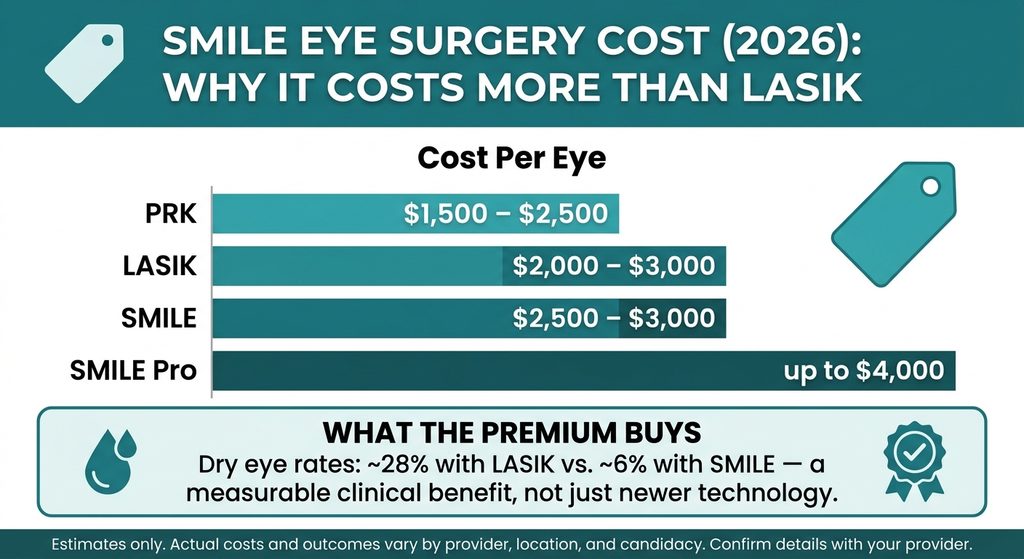
SMILE eye surgery cost typically runs $2,000 to $4,000 per eye, with most patients paying $2,500 to $3,000 per eye. Premium “SMILE Pro” technology can reach $4,000 per eye. That’s generally $500 to $1,000 more per eye than LASIK, mainly because SMILE requires a specific femtosecond laser system (commonly the ZEISS VisuMax) that far fewer practices have invested in.
Because SMILE is only offered at a limited number of centers, comparing SMILE eye surgery cost across multiple providers may mean traveling farther than you would for LASIK, which is available almost everywhere.
SMILE Eye Surgery Cost vs. LASIK and PRK
| Procedure | Typical cost per eye |
|---|---|
| PRK | $1,500 – $2,500 |
| LASIK (standard to custom) | $2,000 – $3,000 |
| SMILE | $2,500 – $3,000 |
| SMILE Pro (premium) | Up to $4,000 |
All three procedures generally achieve comparable long-term vision correction. The price differences mostly reflect the technology and equipment involved, not a difference in final visual outcome for appropriately selected candidates.
Why SMILE Eye Surgery Cost Runs Higher
A few concrete factors explain the premium, rather than it simply being marketing:
- Specialized equipment. SMILE requires a specific femtosecond laser platform, a significant capital investment that fewer practices have made compared to standard LASIK equipment.
- Fewer providers offer it, which reduces the local price competition that helps keep LASIK pricing relatively uniform across most markets.
- A measurable clinical benefit. SMILE preserves more corneal nerves than LASIK, since it doesn’t require creating and lifting a full corneal flap. Some data shows dry eye rates as low as 6% with SMILE, compared to roughly 28% with LASIK — a meaningful difference for patients prone to dry eye.
Because that dry eye reduction is a real, measurable clinical outcome rather than just a marketing claim, the premium buys something specific for the right candidate — not simply a newer-sounding technology.
Who’s Actually a Candidate for SMILE
This matters more here than with LASIK vs. PRK, since SMILE has a narrower treatment range. SMILE primarily treats:
- Nearsightedness (myopia), with or without astigmatism
- Lower to moderate prescriptions — SMILE typically isn’t recommended for high degrees of myopia or astigmatism
SMILE does not treat farsightedness the way LASIK can, which rules it out entirely for some patients regardless of budget. Before comparing SMILE eye surgery cost to LASIK, confirming your specific prescription falls within SMILE’s treatable range is the real first step — cost comparisons don’t matter if you’re not a candidate for one of the two procedures.
Does Insurance Cover SMILE?
Almost never. Like LASIK and PRK, SMILE is classified as an elective procedure, so standard health and vision insurance typically exclude it. A small number of employer-sponsored vision plans and TRICARE (for eligible military members) cover laser vision correction in specific documented cases, though this remains uncommon. See our guide on does insurance cover LASIK for the specific military exception in more detail.
Ways to Lower SMILE Eye Surgery Cost
- HSA and FSA funds cover SMILE as an eligible medical expense, since it qualifies the same way LASIK and PRK do — an effective discount of 20% to 35% depending on your tax bracket.
- Employer vision plan discounts, where available, sometimes reduce laser vision correction costs by 10% to 20%.
- Financing plans through CareCredit, Alphaeon Credit, or in-house payment plans commonly offer 0% APR for 12 to 24 months.
- Traveling to a center that offers SMILE, if none exist near you, is sometimes still cheaper overall than an alternative procedure that doesn’t fit your needs as well — worth weighing travel cost against candidacy fit, not just sticker price.
The American Academy of Ophthalmology publishes patient guidance on laser vision correction options, and the FDA’s LASIK resource page covers general laser eye surgery risk information relevant across procedure types.
Questions to Ask Before You Book
- Does my specific prescription fall within SMILE’s treatable range, or would I need LASIK or PRK instead?
- Does this quote include the pre-op exam, corneal mapping, and all follow-up visits?
- What’s your practice’s experience level specifically with SMILE, separate from LASIK volume?
- If I’m prone to dry eye, how much does that factor into recommending SMILE over LASIK for my case?
- Are there any current promotions, and does the promotional price include everything the standard quote does?
Frequently Asked Questions
Why is SMILE eye surgery cost higher than LASIK if the results are similar? Mainly because of equipment cost and limited provider availability, not because SMILE produces meaningfully better vision for every patient. For patients prone to dry eye, SMILE does offer a specific, measurable clinical advantage that can justify the premium.
Can everyone get SMILE instead of LASIK? No. SMILE mainly treats nearsightedness and astigmatism within a moderate range — it doesn’t correct farsightedness, and it’s not recommended for very high prescriptions. Your specific prescription determines candidacy before cost becomes relevant.
Is it worth traveling to a different city for SMILE? It can be, if SMILE genuinely fits your candidacy better than LASIK or PRK — for example, if you have a history of dry eye. Weigh the travel cost against how much better SMILE fits your specific situation, not just the sticker price difference.
Does SMILE recovery differ from LASIK recovery? Recovery is broadly similar to LASIK in most cases, generally faster than PRK, though individual healing time varies. Ask your surgeon for a recovery timeline specific to your case.
Sources and pricing benchmarks referenced in this guide come from 2026 provider pricing and industry cost surveys in the US. This article doesn’t recommend any specific clinic or surgeon. Confirm current pricing directly with a provider, and consult a licensed ophthalmologist to determine whether SMILE fits your prescription.