
Stem cell therapy cost for knee pain spans an unusually wide range — from around $3,500 to $25,000 per knee. That gap exists partly because pricing varies by clinic and location, but also because “stem cell therapy” isn’t one standardized product. No orthopedic stem cell treatment currently has FDA approval, so pricing, quality, and even the science behind different providers’ claims vary more than in most other treatments in this guide.
This guide breaks down stem cell therapy cost for knees in 2026 by treatment tier and location, what insurance will and won’t pay for, and the questions worth asking before you commit — since regulatory oversight here is lighter than in most other procedures covered on this site.
This article is for general informational purposes only. It is not medical advice and does not replace a consultation with an orthopedic specialist. As of 2026, the FDA has not approved stem cell therapy for orthopedic conditions, and research on its effectiveness for knee pain remains mixed. Figures are 2026 industry estimates based on published clinic pricing. Ask your provider for a full, written quote, and ask about the evidence behind their specific protocol before starting treatment.
Quick Answer
Stem cell therapy cost for a single knee typically runs $3,500 to $25,000, with most patients paying $5,000 to $12,000 for a complete protocol. A simple, same-day injection using your own cells (autologous) generally costs less, while protocols involving lab-processed or expanded cells run toward the higher end.
Because no orthopedic stem cell treatment has FDA approval, standard health insurance and Medicare almost never cover the procedure itself — though they often still cover the consultation and imaging that lead up to it.
Stem Cell Therapy Cost by Treatment Tier
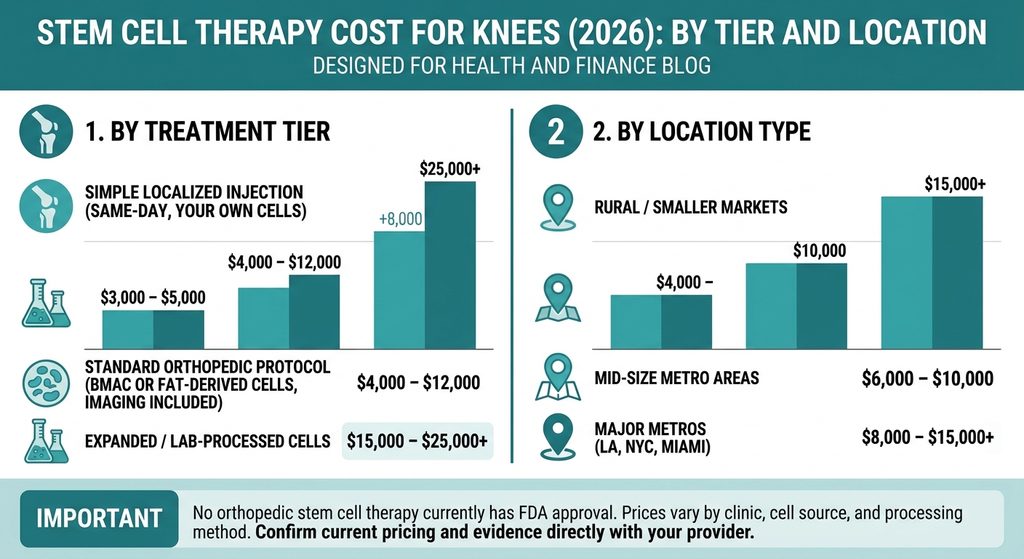
Providers generally price this treatment in a few recognizable tiers:
| Tier | What it typically includes | Typical cost per knee |
|---|---|---|
| Simple localized injection | Same-day, autologous (your own) cells, minimal imaging | $3,000 – $5,000 |
| Standard orthopedic protocol | BMAC or adipose-derived cells, imaging guidance included | $4,000 – $12,000 |
| Expanded or lab-processed cells | Cells cultured or processed by a third-party lab before injection | $15,000 – $25,000+ |
Since the “injection only” price sometimes advertised (commonly quoted around $2,728 in industry surveys) often excludes diagnostics, imaging guidance, and follow-up care, that number can roughly double once the full protocol is added. So always ask whether a quoted price covers the complete visit or just the injection itself.
Stem Cell Therapy Cost by Location
Where you get treated changes the price by a meaningful margin:
| Location type | Typical cost per knee |
|---|---|
| Rural or smaller markets | $4,000 – $8,000 |
| Mid-size metro areas | $6,000 – $10,000 |
| Major metros (e.g., Los Angeles, New York, Miami) | $8,000 – $15,000+ |
High cost-of-living states, particularly California, New York, and Florida, tend to charge 30–50% more than clinics in Texas or the Midwest for a comparable procedure. Treating both knees, or adding a second joint like a hip or shoulder, typically adds $3,000 to $7,000 per additional site rather than doubling the total cost outright. For the surgical alternative on the hip specifically, see our hip replacement surgery cost guide.
How Stem Cell Therapy Cost Compares to Alternatives
Because stem cell injections sit in the middle of a broader spectrum of joint treatments, it helps to see where they fall on price — and where the evidence for each option currently stands:
| Treatment | Typical cost | What the evidence shows |
|---|---|---|
| Cortisone injection | $100 – $300 | Well-established, provides temporary relief (3–6 months) |
| Hyaluronic acid (gel) injections | $600 – $1,200 per series | Established option for knee osteoarthritis |
| PRP (platelet-rich plasma) | $800 – $2,500 | Some supporting evidence; not FDA-approved for this use either |
| Stem cell therapy | $3,500 – $25,000 | Mixed evidence; a 2023 study of 480 patients found no significant difference versus corticosteroid injections at one-year follow-up |
| Total knee replacement (surgery) | $30,000 – $70,000+ | Well-established, insurance typically covers a large portion when medically necessary |
Because the research on stem cell therapy’s effectiveness for knee pain is still developing, cost shouldn’t be the only factor in deciding whether it’s the right option for your case — that’s a conversation worth having directly with an orthopedic specialist. If surgery becomes the right path, see our knee replacement cost with insurance guide for what that alternative actually costs.
Does Insurance Cover Stem Cell Therapy Cost?
Almost never for the procedure itself. Since the FDA hasn’t approved any stem cell therapy for orthopedic conditions, insurers — including Medicare — generally classify these treatments as experimental or investigational and deny coverage on that basis. That said, insurance does often cover the steps leading up to it:
- Consultations with a specialist — typically covered like any other specialist visit
- Diagnostic imaging (X-rays, MRI) — usually covered when ordered to evaluate your knee
- FSA and HSA funds — most patients can use these pre-tax accounts to pay for the procedure itself, which effectively reduces the net cost
Because the procedure itself is rarely covered, it’s worth asking your clinic to bill the consultation and imaging separately through insurance, and to give you a clear, separate quote for the treatment itself.
Red Flags to Watch For
Because this treatment operates with less regulatory oversight than an FDA-approved procedure, a few warning signs matter more here than elsewhere in this guide:
- Any claim of FDA approval for orthopedic stem cell therapy — no such approval currently exists, so this claim alone is a serious red flag
- Guarantees of specific outcomes, since individual results vary and no clinic can honestly promise a particular result
- Pressure to decide same-day, especially for a high-cost, elective treatment
- Refusal to provide an itemized quote covering diagnostics, the procedure, and follow-up separately
A reputable provider should be able to explain their specific cell-processing method, share their track record, and answer direct questions about the evidence behind their protocol without pressure or vague reassurances.
Questions to Ask Before You Pay
- How many knee procedures like mine have you performed, and can you share outcome data?
- Which cell source and processing method do you use, and why?
- Does this quote include diagnostics, imaging guidance, and follow-up visits, or are those separate?
- What does current research actually show for a case like mine, not just for stem cell therapy in general?
- What’s your policy if the treatment doesn’t improve my symptoms?
The FDA’s consumer guidance on regenerative medicine explains which stem cell products currently have approval and how to spot unproven claims. The American Academy of Orthopaedic Surgeons also publishes patient information on regenerative treatments for knee pain, separate from any single provider’s marketing.
Frequently Asked Questions
Why is stem cell therapy cost so much higher than a cortisone shot? Mostly because stem cell procedures involve harvesting, processing, and precisely injecting a patient’s own cells (or, in some protocols, lab-cultured cells), which takes more time, equipment, and specialized handling than a standard cortisone injection.
Does a higher stem cell therapy cost mean better results? Not necessarily. Since research on effectiveness is still developing and no protocol has FDA approval for this use, price mainly reflects the cell source, processing complexity, and clinic overhead — not a guaranteed outcome.
Can I use my HSA or FSA to pay for stem cell therapy? Yes, in most cases. Since these accounts use pre-tax dollars, this effectively lowers your net cost even though the procedure itself isn’t insurance-covered.
Is traveling abroad for cheaper stem cell therapy a good idea? Some patients do pursue treatment outside the US to reduce cost, particularly in Mexico. This adds the same due-diligence questions listed above, plus travel and follow-up logistics, so it’s worth researching the specific clinic and protocol as carefully as you would a domestic provider.
Sources and pricing benchmarks referenced in this guide come from 2026 clinic pricing data and published orthopedic industry surveys. This article doesn’t recommend any specific clinic or treatment protocol. Confirm current pricing and evidence directly with a provider, and consult a board-certified orthopedic specialist to discuss whether stem cell therapy fits your case.