
Sperm freezing cost splits into two very different pieces: a one-time fee for collection and processing, and a recurring annual storage fee that continues for as long as you keep your sample frozen. Because that second piece repeats every year, the real long-term cost depends heavily on how many years you plan to store, not just the upfront price.
This guide breaks down sperm freezing cost in 2026: the initial fee, annual storage pricing, what a 5- or 10-year total actually looks like, and whether insurance ever helps cover it. For the female-side equivalent, see our egg freezing cost by state guide.
This article is for general informational purposes only. It is not medical advice and does not replace a conversation with a urologist or fertility specialist. Figures are 2026 industry estimates based on published clinic and sperm bank pricing. Confirm current pricing directly with a specific provider before proceeding.
Quick Answer
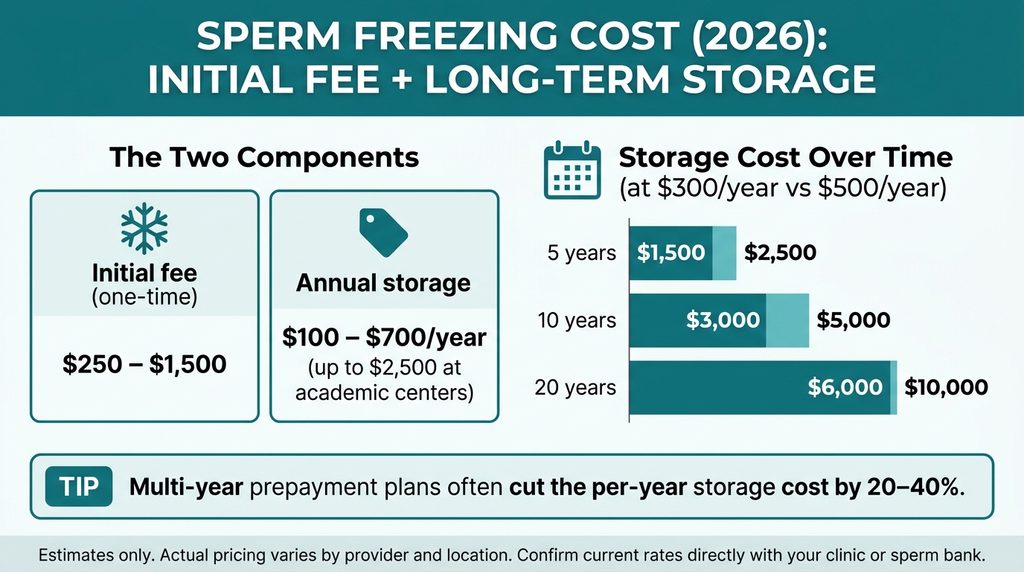
Sperm freezing cost typically starts at $250 to $1,500 for the initial collection, analysis, and cryopreservation. Annual storage adds $100 to $700 per year at most clinics and sperm banks, though some academic medical centers charge up to $2,500 per year. Most men pay under $2,500 total for their first year, including both the initial fee and storage.
Because storage fees repeat annually, the total cost over 10 years can meaningfully exceed the initial fee — worth factoring in before you commit to a specific provider.
Sperm Freezing Cost: The Two Components
Every provider bills sperm freezing in two separate pieces:
| Component | Typical cost | What it covers |
|---|---|---|
| Initial fee (one-time) | $250 – $1,500 | Consultation, infectious disease screening, semen analysis, and the cryopreservation process itself |
| Annual storage | $100 – $700 per year (up to $2,500 at some academic centers) | Keeping your sample in liquid nitrogen tanks, facility operations, and specimen insurance |
Many clinics recommend freezing two to three samples, spaced a few days apart, to maximize the number of vials available for future use. Each additional collection typically adds $150 to $500 to your initial cost.
Sperm Freezing Cost by Provider Type
Where you freeze changes both pieces of the price:
| Provider type | Typical initial fee | Typical annual storage |
|---|---|---|
| At-home collection kit (e.g., mailed kit) | Often bundled, from ~$245/year | Included in the bundled annual price |
| Standard fertility clinic or sperm bank | $500 – $1,500 | $150 – $500 |
| Academic medical center | $1,000 – $1,500 | Up to $2,500 |
At-home kits let you collect a sample privately and ship it to a lab for freezing, often at a lower bundled price than a traditional clinic visit. Academic medical centers tend to charge more for storage specifically, though they may also serve patients with more complex medical situations, such as active cancer treatment.
What Long-Term Storage Actually Costs
Because storage fees repeat every year, it helps to see the real multi-year total rather than just the first-year price:
| Storage duration | At $300/year | At $500/year |
|---|---|---|
| 5 years | $1,500 | $2,500 |
| 10 years | $3,000 | $5,000 |
| 20 years | $6,000 | $10,000 |
Many providers offer discounted multi-year prepayment plans, commonly reducing the per-year cost by 20% to 40% compared to paying annually. If you’re confident you’ll store for many years, prepaying a multi-year block is usually worth pricing out before committing to annual billing.
Why Men Freeze Sperm
Sperm freezing serves several distinct purposes, and the reason often affects how urgently you need to act:
- Before cancer treatment — chemotherapy, radiation, or surgeries like orchiectomy can reduce or eliminate sperm production, making pre-treatment freezing time-sensitive
- Before a vasectomy — freezing beforehand preserves the option to have biological children later without reversal surgery
- Before military deployment — some service members freeze sperm as a precaution before extended deployment
- Before gender-affirming treatment — hormone therapy can affect fertility, so some patients freeze sperm beforehand
- General reproductive insurance — some men freeze sperm simply to preserve fertility for a later time, independent of any specific medical reason
Does Insurance Cover Sperm Freezing Cost?
Almost never, even when the reason is medical. Most insurance plans exclude sperm freezing from coverage, including cases tied to cancer treatment. That said, a documented workaround sometimes helps: some hospitals have successfully billed the procedure as part of cancer treatment or “procreative management” rather than as a standalone fertility service, which occasionally results in partial coverage. It’s worth asking your oncology team and insurer directly whether this framing applies to your specific situation, rather than assuming coverage is impossible before checking.
HSA and FSA funds generally do cover sperm freezing as an eligible medical expense, which effectively discounts the cost by your marginal tax rate even without insurance coverage.
The Johns Hopkins Medicine sperm banking guide explains the medical screening and freezing process in detail, and the American Society for Reproductive Medicine publishes broader patient guidance on fertility preservation options for men.
Questions to Ask Before You Choose a Provider
- What does the initial fee include, and does it cover more than one collection if needed?
- What’s your annual storage fee, and do you offer a discounted multi-year prepayment option?
- If I need to transfer my sample to a different clinic later, is that possible, and what does it cost?
- Do you have experience working with patients in my specific situation (for example, pre-chemotherapy timing)?
- What happens to my sample if I stop paying the storage fee?
Frequently Asked Questions
Is sperm freezing cost cheaper than egg freezing? Yes, significantly. Sperm freezing’s initial fee and annual storage cost are both a fraction of egg freezing’s, mainly because the collection process is far less invasive and doesn’t require hormone stimulation or a surgical retrieval procedure.
How long can frozen sperm actually be stored? Properly cryopreserved sperm can remain viable for decades, according to reviewed clinical research, so a long storage duration by itself isn’t a reason to worry about sample quality declining.
Do I need to freeze multiple samples? Many clinics recommend it, since freezing two to three samples increases the number of vials available for future attempts, particularly if you may need multiple fertility treatment cycles later.
What happens to my stored sample over time if I don’t use it? As long as you continue paying the storage fee, most providers keep the sample stored indefinitely. Policies on what happens after non-payment vary by provider, so it’s worth asking directly before you sign up.
Sources and figures referenced in this guide come from 2026 clinic and sperm bank pricing data. This article doesn’t recommend any specific clinic or sperm bank. Confirm current pricing directly with a provider, and consult a urologist or fertility specialist to determine whether sperm freezing fits your situation.