
Egg freezing cost by state varies more than most treatments in this guide, mainly because the price splits into three separate pieces — the procedure itself, medications, and ongoing storage — and each piece moves independently depending on where you live and which clinic you choose.
This guide breaks down egg freezing cost by state and region in 2026, what each component of the price actually covers, and what to budget for later, since using your frozen eggs down the line involves its own separate cost. For the male-side equivalent, see our sperm freezing cost guide, or IVF cost by state for how state insurance mandates affect fertility treatment generally.
This article is for general informational purposes only. It is not medical advice and does not replace a consultation with a fertility specialist. Figures are 2026 industry estimates based on published clinic pricing and fertility-finance data. Ask your clinic for a full, written quote before starting treatment.
Quick Answer
One cycle of egg freezing typically costs $12,000 to $20,000 all-in — including the procedure, medications, and the first year of storage. Because many patients need more than one cycle, a realistic two-cycle budget often runs $24,000 to $36,000. On top of that, storage adds $500 to $1,000 per year after the first year, and using the eggs later through IVF adds a separate cost when that time comes.
Location moves this number significantly: major metros like New York City and Los Angeles often run toward $16,000–$24,000 per cycle, while metros with a lower cost of living, such as Atlanta, Phoenix, and Dallas, tend to run closer to $9,000–$14,000.
What Egg Freezing Cost Actually Includes
Since clinics rarely bundle everything into one number, it helps to see the three pieces separately:
| Component | Typical cost |
|---|---|
| Procedure (monitoring, retrieval, freezing) | $4,000 – $15,000 per cycle |
| Fertility medications | $3,000 – $6,000 per cycle |
| Storage, first year | Often included in the cycle price |
| Storage, each year after | $500 – $1,000 per year |
Because the procedure fee alone can look deceptively low, always ask whether medications and the first year of storage are included, or billed as extras. A clinic advertising a low “starting at” price sometimes means the procedure fee only — not the full cycle.
Egg Freezing Cost by State
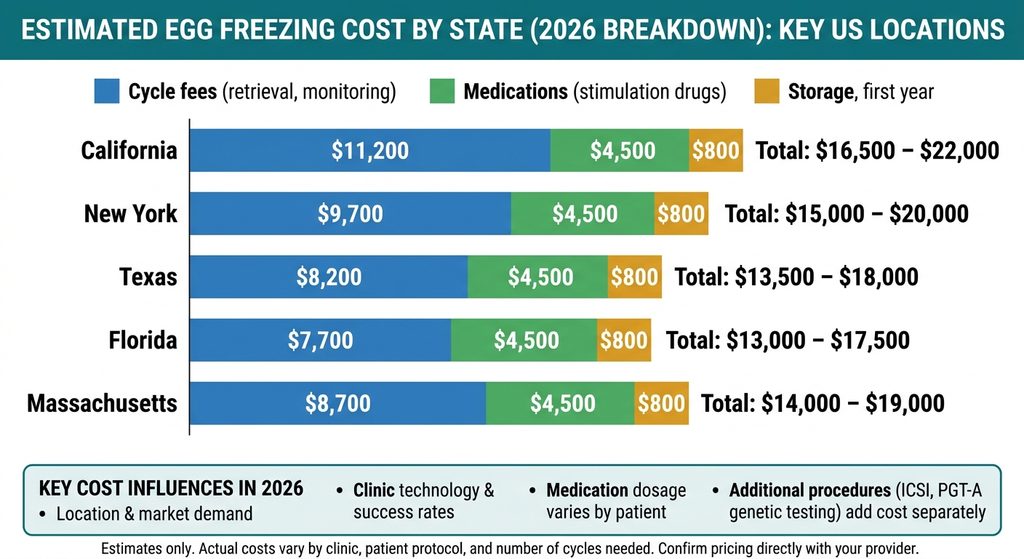
Exact pricing changes often and varies by clinic, but here’s how the total typically breaks down in five representative states:
| State | Cycle fees (retrieval, monitoring) | Medications | Storage, year 1 | Total (all-in) |
|---|---|---|---|---|
| California | $11,200 | $4,500 | $800 | $16,500 – $22,000 |
| New York | $9,700 | $4,500 | $800 | $15,000 – $20,000 |
| Massachusetts | $8,700 | $4,500 | $800 | $14,000 – $19,000 |
| Texas | $8,200 | $4,500 | $800 | $13,500 – $18,000 |
| Florida | $7,700 | $4,500 | $800 | $13,000 – $17,500 |
The main driver behind the state-to-state gap is the cycle fee — the retrieval and monitoring portion — which tracks closely with each area’s cost of living and clinic demand. Medications and first-year storage stay fairly consistent nationwide, since those are priced more by pharmacy and lab standards than by local market.
Because clinic pricing pages change frequently, confirm current numbers directly with clinics in your specific state rather than relying on a national average alone.
Does Insurance Cover Egg Freezing Cost by State?
It depends heavily on why you’re freezing your eggs and which state you’re in. Elective egg freezing — done for personal or social reasons rather than a medical diagnosis — is rarely covered by standard health insurance. Medically necessary freezing, such as before chemotherapy or as part of gender-affirming care, gets covered far more often.
On the state side, 25 states plus Washington, D.C. currently have some form of fertility-coverage mandate, and a handful of states expanded these mandates in 2026. That said, two things limit how far these mandates actually reach:
- Self-funded employer health plans are exempt from state mandates in most cases, and self-funded plans cover a large share of Americans with employer insurance.
- Even where a mandate applies, it often only requires coverage for medically necessary preservation, not elective freezing.
Because of this, it’s worth confirming directly with your insurer (or your employer’s HR department, since self-funded plans aren’t always obvious from your insurance card) whether your specific situation qualifies before assuming a state mandate applies to you.
Employer Benefits: An Increasingly Common Alternative
Since insurance coverage is so inconsistent, a growing number of employers — particularly in tech, finance, and healthcare — now offer egg freezing as a standalone benefit, separate from standard health insurance. Coverage ranges from a partial subsidy to one or more fully covered cycles. Because this benefit isn’t always advertised alongside standard insurance, checking your specific benefits package (or asking HR directly) is worth doing even if you assume your employer doesn’t offer it.
The Cost You’ll Pay Later: Using Your Frozen Eggs
Freezing the eggs is only the first half of the cost. When you’re ready to use them, the process runs through IVF, which adds its own separate expense:
| Step | Typical national cost |
|---|---|
| Thawing and fertilizing frozen eggs (frozen egg IVF) | ~$13,200 |
| Frozen embryo transfer (FET), including medications and monitoring | ~$7,200 |
Because this second phase can happen years after the original freezing cycle, it’s easy to budget only for the freezing itself and forget that using the eggs later carries its own multi-thousand-dollar cost — worth factoring into your long-term financial plan from the start. See our IVF cost without insurance guide for the full breakdown of that later phase.
Questions to Ask Before You Book a Cycle
- Does this quote include medications, or are those billed separately through a pharmacy?
- Is the first year of storage included in the cycle price?
- What’s your refund or credit policy if the cycle is cancelled due to a poor medication response?
- Based on my age and ovarian reserve, how many cycles do you realistically expect I’ll need?
- Do you offer multi-cycle package pricing if I’m likely to need more than one?
The American Society for Reproductive Medicine and the Society for Assisted Reproductive Technology both publish patient resources on egg freezing outcomes and typical costs by clinic.
Frequently Asked Questions
Why does egg freezing cost by state vary so much even within the same state? Mostly because pricing clusters more by metro area and clinic tier than by state line. A clinic in a smaller city within an otherwise expensive state can still price well below the state’s major metro.
How many cycles do most people actually need? It depends heavily on age and ovarian reserve. Younger patients with a strong ovarian reserve often reach their egg-count goal in one or two cycles, while patients in their late 30s commonly need two to three.
Is a low advertised price for egg freezing a red flag? Not automatically, but it’s worth confirming exactly what the number includes. Some clinics advertise the procedure fee alone and bill medications and storage separately, which can make two seemingly different quotes actually quite close once you account for everything.
Does freezing eggs earlier always cost less overall? Often, yes, mainly because younger patients typically need fewer cycles to freeze an adequate number of eggs — but this is a clinical question as much as a financial one, so it’s worth discussing your specific case with a fertility specialist rather than deciding on cost alone.
Sources and figures referenced in this guide come from 2026 fertility-industry pricing data, clinic cost pages, and state insurance-mandate tracking. This article doesn’t recommend any specific clinic or financing provider. Confirm current pricing directly with a fertility clinic, and speak with a reproductive endocrinologist to discuss what timeline and cycle count make sense for you.