
IVF cost by state depends less on which state you live in than most people assume. It depends far more on one detail: whether your employer’s health plan is self-funded. That single factor can matter more than your state’s insurance mandate. Federal law exempts self-funded plans from state requirements entirely, and self-funded plans cover roughly 65% of Americans with job-based insurance.
This guide breaks down IVF cost by state in 2026. You’ll see which states mandate fertility coverage, what those mandates typically do and don’t include, and how to find out what actually applies to you — rather than relying on your state alone. For the full self-pay breakdown, see our IVF cost without insurance guide, or egg freezing cost by state if fertility preservation is your goal.
This article is for general informational purposes only. It is not legal, financial, or medical advice and does not replace a conversation with your insurer, your employer’s HR department, or a fertility specialist. Figures are 2026 estimates based on published state legislation and insurance-industry data, which changes frequently. Confirm your specific plan’s coverage directly with your insurer or HR department.
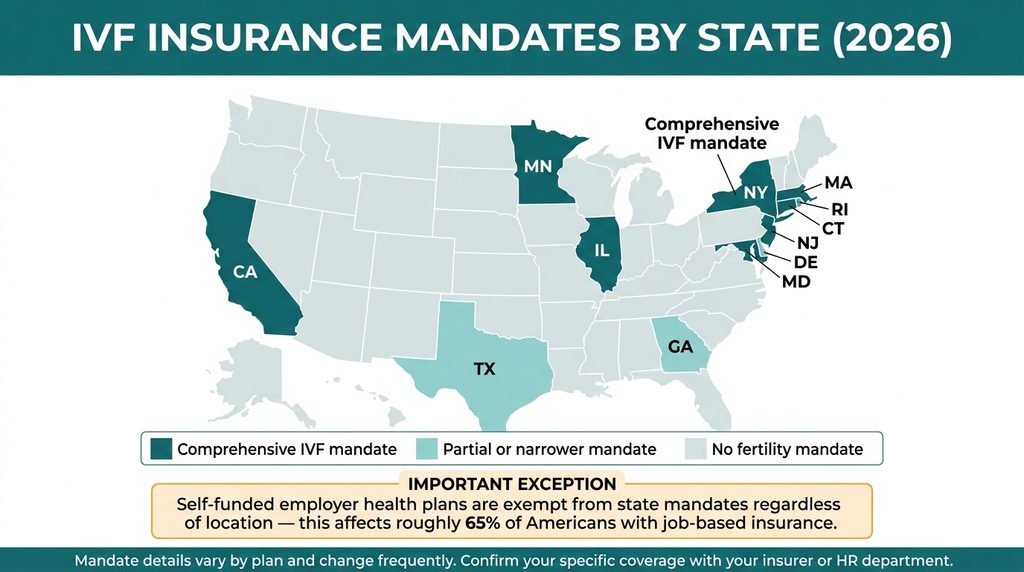
Quick Answer
As of 2026, 25 states plus Washington, D.C. have some form of fertility-coverage mandate. Only about 13 to 15 of those specifically require IVF coverage, rather than just infertility diagnosis or preservation services. Even in a strong mandate state, federal law exempts self-funded employer plans from the requirement entirely — and those plans cover a majority of workers with job-based insurance.
Because of that exemption, your employer’s plan type usually matters more than your zip code for your real IVF cost by state.
IVF Cost by State: Mandate Strength Tiers
State mandates vary enormously in what they actually require. Here’s how a sample of states compare:
| State | Mandate type | What it typically covers |
|---|---|---|
| New York, New Jersey, Massachusetts, Illinois, Maryland, Rhode Island, Connecticut, Delaware | Comprehensive IVF mandate | Multiple IVF cycles, often with defined limits (for example, Illinois requires up to six cycles, or four without a prior live birth) |
| California, Minnesota | Comprehensive mandate (effective January 1, 2026) | Large-group plans must cover infertility diagnosis and treatment, including IVF — California’s law covers up to three egg retrievals with unlimited transfers |
| Georgia | Narrower 2026 mandate | Fertility preservation coverage for cancer patients specifically, not a general IVF requirement |
| Texas | “Mandate to offer,” not “mandate to cover” | Insurers must offer IVF coverage as an option, but employers aren’t required to include it in their plan |
| Roughly half of all states | No fertility mandate | IVF coverage depends entirely on your specific employer or individual plan |
Comprehensive mandate states still differ in cycle limits, age requirements, and marital-status rules. Living in a mandate state is a helpful starting point — not a guarantee of what your specific plan will pay for.
The Self-Funded Loophole: Why Your State May Not Matter
This is the single most important thing to understand about IVF cost by state. Under federal law (ERISA), the federal government regulates self-funded employer health plans instead of state insurance law. That makes them exempt from state fertility mandates entirely — even if your employer is headquartered in a state with a strong IVF mandate.
Roughly 65% of Americans with employer-sponsored insurance have a self-funded plan, so this exemption affects far more people than the mandate maps suggest. In practice, that means:
- Two coworkers at different companies in the same mandate state can have completely different IVF coverage, depending on whether each employer’s plan is self-funded or fully insured
- Many large employers self-fund their health plans because it gives them more flexibility over benefit design. This isn’t unusual or a red flag — it’s a common structure
- The only reliable way to know your actual coverage is to ask HR directly whether your plan is self-funded or fully insured. This usually isn’t obvious from your insurance card
What Changed for 2026
Fertility coverage mandates continue to expand. Some of the most significant 2026 changes:
- California’s SB 729 took effect January 1, 2026. It requires large fully-insured group plans (100+ employees) to cover infertility diagnosis and treatment, including IVF — with up to three completed egg retrievals and unlimited embryo transfers.
- Minnesota’s Building Families Act also took effect January 1, 2026, adding Minnesota to the list of comprehensive-mandate states.
- Georgia’s HB 94 added a narrower fertility preservation mandate specifically for cancer patients, rather than a general IVF coverage requirement. That’s an important distinction if you’re checking whether your state “covers IVF.”
More than half of states introduced or carried over fertility-related legislation in 2026. This landscape keeps shifting, so it’s worth checking current status rather than relying on outdated mandate lists.
How State Mandates Affect Your Actual IVF Cost
When a mandate applies to your plan, it typically changes your out-of-pocket cost dramatically. A $17,000–$31,500 self-pay cycle often shrinks to a standard deductible-and-coinsurance amount, similar to any other covered medical procedure. When no mandate applies — either because your state has none, or your plan is self-funded — you’re generally looking at the full self-pay range, regardless of which state you live in.
Self-pay clinic pricing itself also varies by local market, independent of any insurance mandate. So patients in expensive metro areas without coverage face a combined effect: a higher local price and no mandate protection.
How to Find Out What Actually Applies to You
- Ask HR directly whether your health plan is self-funded or fully insured — this single question often matters more than checking your state’s mandate status.
- Call your insurer and ask specifically about your plan’s infertility and IVF benefit, including cycle limits, age restrictions, and any marital-status requirements.
- Check RESOLVE’s fertility insurance coverage map for the current, detailed breakdown of what your specific state’s law does and doesn’t require.
- Ask about employer-specific fertility benefits, since a growing number of large employers offer fertility coverage as a standalone benefit that goes beyond what their state or plan type would otherwise require.
The RESOLVE: The National Infertility Association maintains an interactive, regularly updated map of state fertility insurance laws, and the American Society for Reproductive Medicine publishes patient guidance on navigating insurance coverage for fertility treatment.
Frequently Asked Questions
If my state mandates IVF coverage, am I guaranteed coverage? Not necessarily. Federal law exempts self-funded employer plans from state mandates regardless of location. Even fully-insured plans in mandate states often have cycle limits, age requirements, or marital-status rules that could affect your specific situation.
How do I know if my employer’s plan is self-funded? It usually isn’t obvious from your insurance card alone. Asking HR or benefits directly is the most reliable way to find out. This detail matters more than your state’s mandate for your actual coverage.
Do state mandates cover egg freezing the same way as IVF? Not always. Many mandates that require IVF coverage don’t require elective egg freezing coverage. That said, mandates specifically covering fertility preservation for medical reasons — such as before chemotherapy — are becoming more common.
Should I move or change jobs to get better IVF coverage? Some patients do factor fertility benefits into major life or career decisions. Still, it’s worth confirming a specific employer’s actual plan details — fully insured versus self-funded, and the specific fertility benefit offered — rather than assuming a state’s mandate alone guarantees better coverage.
Sources and figures referenced in this guide come from 2026 state legislation tracking, insurance-industry reports, and employer benefits data. This article doesn’t recommend any specific insurer, employer, or clinic. Confirm your specific coverage directly with your insurer or HR department, and speak with a reproductive endocrinologist to discuss your treatment options.